
It’s any seller’s nightmare: You put your house on the market hoping for a quick sale — but boy, were you wrong. There hasn’t been a single offer, and showing requests are few and far between, leaving you to ask: Why isn’t my home selling?
It’s frustrating, to say the least, but you shouldn’t wait any longer to make some changes, especially if your home’s total days on market is more than a month. Your days on market (DOM) matter because the longer a house sits compared to other homes in your area, the more buyers will suspect something might be wrong. Acting quickly can keep buyers interested and stop your property from sitting too long, so don’t wait to make changes.
Speed Up Your Home Sale With a Cash Offer or Top Agent
Get a no-obligation all-cash offer through HomeLight’s Simple Sale platform in 24 hours. You’ll also see an estimate of what a top-performing agent might be able to get for your home.
Alisha Simpkins, a top-selling Chico, California real estate agent, says a home is “going to sell for the most amount of money in the first 30 days.” Underlining this point, this analysis by a Realtor in Haverhill, Massachusetts, revealed homes that sold within 0–25 days went for 103% of their asking price. After 100 days, the sale-to-list price ratio dropped to 97%.
Before we dive in, try the Home Seller Mistake Mashup Machine below to see which pitfalls you might be facing. Knowing what to address can help you sell faster, keep more of your profit, and avoid surprises along the way.
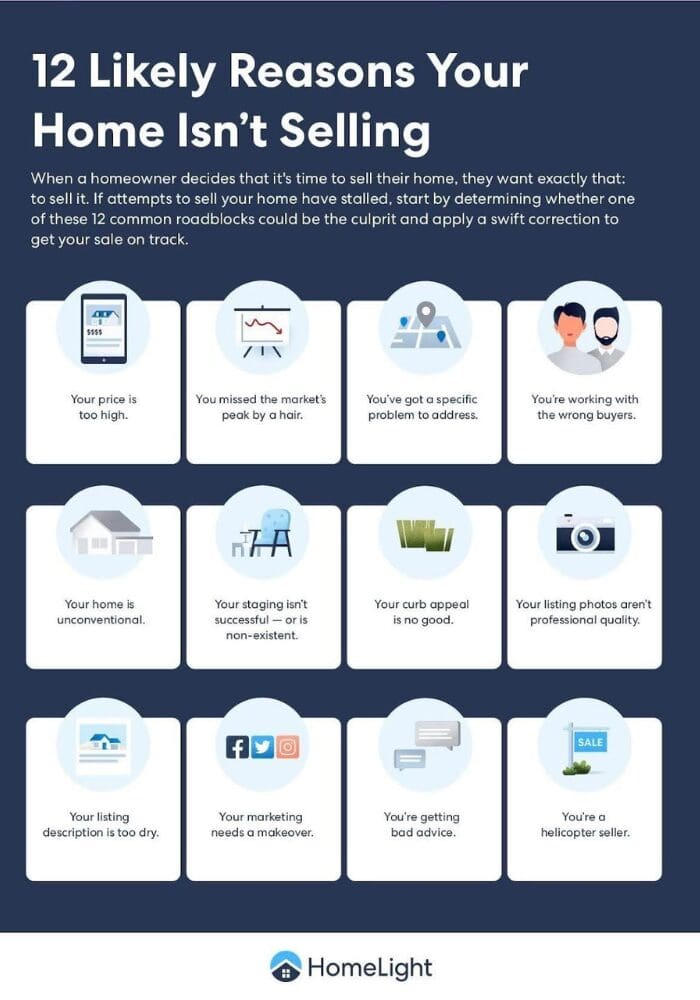
Here are 12 of the most common reasons your home isn’t selling and actions you can take to get your sale back on track.
1. The price is too high
Homebuyers notice when a home is priced too high. In a HomeLight survey of top real estate agents across the country, 77% identified overpricing as the most common error that leads to homes sitting unsold.
“If it’s not a condition, it’s always price,” says Simpkins. “And in fact, it’s usually always [the] price.”
How do you know if your home is priced too high? Pricing a home for sale is deceivingly complex. To predict what buyers would pay, you must carefully review recent sales and make dollar adjustments to your property based on competitive differences.
Our Home Value Estimator can be a helpful tool for this task. Enter your address and answer a few basic questions about your home, and we’ll provide a preliminary home valuation in less than two minutes.
However, an online estimate is just the starting point. If you priced the home yourself, get a real estate agent’s opinion on whether you may have been too ambitious. They’ll likely provide comparative market analysis (CMA), a report that estimates your home’s value by comparing it to similar properties in your area that have recently sold.
-

Regina Madiera-Gorden Real Estate Agent
Regina Madiera-Gorden Real Estate Agent at Windermere West Campus
- Years of Experience 22
- Transactions 601
- Average Price Point $445k
- Single Family Homes 504
Additionally, pay attention to the feedback you get from people at open houses and showings. Were they disappointed at the home’s quality compared to the price?
You can also browse local listings. If your home is priced higher than nearby houses with better features and more upgrades, it’s a telltale signal that price is the issue.
What’s the fix?
In most cases, it’s time for a price drop.
A price cut may sound like the kiss of death for getting the value you’d hoped for. But in reality, price reductions are quite common and sometimes necessary to reel buyers in.
According to data from the National Association of Realtors (NAR), 29% of buyers considered a better price when purchasing a previously owned home.
So, how much should you lower the price?
“You don’t want to be the house that drops the price a thousand dollars every week,” says Simpkins. “I’d say a significant price reduction will get the job done.”
If a listing is getting a lot of showings but no offers, Madiera-Gorden suggests a 1% markdown might entice the right buyers. If there are few showings, a 2% to 3% price reduction may be necessary.
It’s also important to be mindful of online price filters as you come up with your pricing strategy. “Buyers search in $25,000 to $50,000 increments generally,” Madiera-Gorden explains. “So, we try to be cognizant of stepping into the next price bracket, if necessary, to get the property in front of the right buyers.”
2. You missed the market’s peak
Real estate isn’t as volatile as the stock market, but it can quietly shift while you aren’t paying attention. These subtle market changes show up in trends like the number of homes needing price reductions to attract buyers.
According to the NAR, price cuts remain elevated, though they’ve dipped a touch from 15.6% in January 2025 to 14.3% today. If you price your home too high, you risk watching it linger while buyers snap up better deals.
“Homes priced right are selling quickly,” shares Christine Radford, a top real estate agent in Jacksonville, Georgia, a market Radford describes as 60% retirees and pre-retirees.
“[Those] overpriced and not in top condition are sitting longer. We have lots of picky buyers waiting for the right property who are in no rush to buy.”
Recently, Madiera-Gorden worked with sellers who knew of a house down the street with a similar floor plan that sold in two days for $20,000 above the asking price. Since her client’s house had significant upgrades compared to the neighbors’, they planned to set an even higher list price than what the comp sold for.
However, in a mere four months since the neighbor’s sale, “The velocity of the market had really slowed, so we had to adjust our price,” Madiera-Gorden says.
What’s the fix?
Keep up with what’s happening in the market and examine buyers’ options in real time. Madiera-Gorden and her daughter and business partner, Madison Lord, sometimes take their sellers on an in-person or virtual home tour of similar properties.
Taking that journey with a professional allows sellers to better understand how their home compares to others and how they can improve its appeal to buyers.
Depending on the competition, a seller may choose to make some upgrades and renovations or reduce the price accordingly. For example, if every other comparable listing has a furnace that’s less than five years old and yours is upward of 12, maybe it’s time to install a new one.
3. You’ve got a specific problem to address
Even if a showing doesn’t provide you with a buyer, it gives you something important: intel. “Showing feedback is extremely important,” says Simpkins.
According to her, the questions your agent should be collecting from a showing are, “What’s wrong with this home? What would need to change to make you want to buy this home?”
If you get the same answer from multiple people, you know you have a problem.
What’s the fix?
Once you’ve identified that there’s an issue, you can work to mitigate it. If multiple buyers say your house is too dark, you can add lighting, declutter, or hire someone to clean the windows.
If buyers are having trouble envisioning something specific, such as where to hang a TV in a living room full of windows or how to fit a king-sized bed in a smaller master bedroom, you can update your staging to illustrate a solution.
You may also need to address a significant cosmetic flaw or expensive repair. For example, in evaluating one of her listings, Lord noticed a massive splotch on a kitchen counter. She knew buyers would be deterred by having to replace it.
“Our preferred contractors put a new slab of quartz for $2,000,” she says. “Those types of fixes bring you value on the market.”
Aside from addressing problems, a home warranty can help a home sell and attract excellent offers. With the assurance that they won’t face unexpected repair costs after purchase, buyers are more motivated and confident in proceeding with the transaction.
Of course, some things can’t be changed. What if your homeowners’ association (HOA) dues are high or your street is clogged with cars going to the stadium every game day?
“Price cures all,” says Simpkins.
4. You’re working with the wrong buyers
Sometimes your home just isn’t in front of the people who are ready and able to buy it. Let’s say your home needs some work. The roof is getting old, the construction materials may contain asbestos or may not be in the best shape, and there’s water damage you can’t afford to fix. On the open market, most buyers are looking for homes they can move into without major repairs.
Or maybe you listed your home in a rush out of necessity. You need the extra cash, or a loved one is facing a change in health. But things aren’t moving at the speed you need them to. Many buyers are still working through mortgage approval, and your home isn’t reaching those who are ready to act fast.
Sellers who need to sell urgently may find that an off-market sale works better for them. Many buyers can be sticklers about home conditions. According to a NAR Generational Trends Report on Buyers and Sellers, only 23% of buyers compromised on the home’s condition.
What’s the fix?
Sell your home to a real estate investor, house-buying company, or iBuyer instead. Some direct real estate buyers are more accepting of homes that require a little TLC. Most of them present cash offers. Here’s how it usually works: You provide details about your home, the buyer names their cash price, and then you decide whether you want to accept or decline the offer.
If this route interests you, consider requesting a cash offer from HomeLight’s Simple Sale platform. Rather than do the work of pricing your home and staging it for the market, you’ll only answer a few questions, such as how much work the home needs and how soon you plan to sell, so that we can learn more about your situation.
Within 24 hours, we’ll send you a full cash offer, and the deal can close in as little as 7 days. This route provides a low-stress selling experience that’s much quicker than most transactions that require financing.
5. Your home is unconventional
Unique properties — large, high-end, or expensive houses — aren’t for everybody, so they usually take a little longer to sell.
For example, Simpkins recalls a client’s home that had two complete living spaces under the same roof. Although it wasn’t divided into two apartments, the home featured two kitchens, living rooms, and primary bedrooms on different floors.
To sell that property, Simpkins changed her marketing strategy. She concentrated on encouraging buyers to picture space for an Airbnb rental or a suite for live-in relatives.
What’s the fix?
First of all, patience. If your home is unconventional, you’ll probably have to wait for the perfect buyer. Second, consider what appealed to you when you bought the home. Other buyers may feel the same way. Ensure your marketing and advertising strategy positively portrays the distinctive features so the property resonates with buyers who would appreciate its charms.
Finally, get that information in front of the right people. In addition to real estate websites, consider posting on Facebook groups, specialty websites, mailing lists, local apps such as Nextdoor, or even print publications that target your buyers.
6. Your staging is terrible — or non-existent
Showings allow buyers to get a feel for your home and help them envision the space as their own. That’s hard to do if they’re tripping over children’s toys in the dining room or overwhelmed by travel trinkets bulging out of built-in bookshelves. Put simply, unstaged homes can seem cluttered, cramped, dark, and small, and that can quickly turn buyers away.
“Typically, a staged home sells for more money, and it does sell in a shorter amount of time,” says Simpkins.
In a HomeLight survey, about 34% of agents reported that professionally staged homes sell one to two weeks quicker than unstaged ones, while 25% said staging can speed up the sale by three to four weeks in their markets.
“Staging, new paint, and decluttering offer more than an increase in price,” says Stacy Stanley, a top real estate agent in Grass Valley, California.
“It determines how desirable the home is to the market, how many offers it gets, and how fast it sells.”
What’s the fix?
Get a jump on your move by decluttering and depersonalizing, packing up family photos and other collectibles. Now that you can see the floors, walls, shelves, and other spaces, you can determine what to paint or repair.
Since you’re leaving, it’s understandable that you don’t want to fix things you’ve ignored for years. But, little upgrades often bring a considerable return on investment, as can hiring a professional stager.
“The right staging almost always doubles or triples your investment,” says Lord.
If the home is occupied
“If the seller is still living in the house,” Madiera-Gorden says, “we wouldn’t necessarily recommend staging every single bedroom — just your living areas, kitchen, bathrooms, and primary suite.”
Staging a three-bedroom home might cost $1,500 to $4,000. But, “If you partner with the right people,” she continues, “there’s no upfront cost to the seller because the fee is collected out of escrow.”
Moreover, focusing on key spaces only can help reduce home staging costs. As shown in NAR’s Profile of Home Staging report, a staged living room is the most important for buyers (37%), followed by the primary bedroom (34%) and the kitchen (23%).
Remember that less is more. Staging isn’t about scattering potpourri and adding a ton of decor. Good staging focuses on minimizing distractions and maximizing layout and design to highlight a home’s best features.
7. Your curb appeal is no good
Buyers can’t appreciate your excellent interior if they don’t reach the front door or get out of the car. An overgrown yard or rundown facade stops buyers in their tracks. So make your curb appeal irresistible because first impressions could be the difference between a sale and a pass
It’s hard to believe that paint, pressure washing, pine straw, and petunias can translate into thousands of dollars. But numbers don’t lie.
According to HomeLight data, simple upgrades to landscaping and curb appeal can raise the value of a typical home by nearly $8,000.
What’s the fix?
Make the local garden club, or at least other sellers in the neighborhood, green with envy.
Without much effort or expense, you can DIY or work with a professional landscaper and contractor to upgrade your landscaping, get your grass a brilliant green, plant a few flowers, and fix anything weathered or broken on your home’s exterior.
8. Your listing photos aren’t professional quality
After completing all that work on staging and curb appeal, you’ll be excited to show off the house. But if your listing photos aren’t close to magazine quality, nobody will see them in person.
These days, a few poorly lit, blurry iPhone photos won’t cut it.
“We do professional photos, videography, drone footage, and virtual ‘walkable’ layout with every single client,” says Lord. “We even had photos taken for a fixer-upper that wasn’t super attractive because our presentation is always professional.”
The NAR’s Generational Trends report found that 83% of buyers consider professional listing photos as the most valuable website feature in their home search.
What’s the fix?
Amp up your digital marketing, and replace bad photos with professional ones if you haven’t already. Talk to your agent about adding a video listing or 3D walkthrough. Most agents contract with local photographers and pay for those services out of their commission.
If media is not included or you’re listing the property, a small investment in professional photography will deliver huge returns.
9. Your listing description is too dry
“Four-bedroom, two-bath duplex located on Uptown Street.”
Maybe “Just the facts, ma’am,” was all Sergeant Joe Friday needed to catch a crook on 1950s Dragnet. But if your listing lacks imagination, it will fail to capture the attention of today’s buyers.
Listing a home is about more than ticking off boxes. It’s about painting a picture of the lifestyle buyers will enjoy. Is it a three-bedroom with an owner’s suite? Is it a contemporary or a Victorian? Is it near a zoo, park, college, or nightlife?
More than just describing physical location and features, you need to describe how those elements will make life fabulous for the lucky family who gets to live there.
What’s the fix?
Grab a pen and write a love letter to your home. Describe the features that make you love this place, and buyers will feel the magic, too.
“We’re not selling a house so much as we’re selling a lifestyle,” says Madiera-Gorden.
The number of bedrooms, bathrooms, square footage, parking spaces, and other data appear in the basic multiple listing service (MLS) stats.
“We don’t have to reiterate that information in the copy,” she says. “We look at: How can we paint a picture about this house? Who are our buyers? Where’s the opportunity? What can buyers see themselves doing in this home?”
Consult our guide to writing creative real estate listing descriptions that sell for inspiration.
10. Your marketing needs a makeover
If you’re relying on print ads and yard signs alone, you may not be generating excitement or reaching the right buyers. Most of them look at properties for sale online to start the homebuying process. You’re missing out on excellent opportunities if your home isn’t showing up where people are searching.
“Buyers are most likely to find the house online first and send it to their agent,” Lord explains. “It’s so important to be very, very visible on social media and on all of those third-party sites.”
What’s the fix?
Your best strategy is to engage a top-notch sales agent in your area to evaluate your home, identify opportunities, and implement a marketing strategy.
In addition, HomeLight’s Seller Resource Center offers marketing assessment and other tools to help evaluate and maximize your marketing strategy.
11. You’re getting bad advice
Nearly every issue on this list could be avoided by working with an experienced local agent. Your expert partner should collaborate on pricing, staging, and curb appeal, drive marketing efforts, and analyze feedback from showings to determine whether changes are needed.
Simpkins recalls an initial meeting with a potential client whose backyard lacked privacy. When she suggested installing a bamboo fence and making other improvements, the seller chose another agent.
The property didn’t sell in six months, so the seller rented it. The renter caused significant damage. “It cost my seller quite a bit of money to get the house back into the proper condition [and] on the market,” she says.
Regretting his prior decision, the seller asked Simpkins to represent him.
After allowing her landscaper to make the recommended changes to the backyard, “We actually received an offer within a week of putting it on the market,” Simpkins says.
What’s the fix?
Make sure you’re working with an agent who is an expert in your area or the kind of home you’re trying to sell. Whether from a well-meaning agent friend or relative from across town or on the other side of the country, advice from out-of-area agents or those specializing in a different property type can be a gamble.
“Their pricing can be off by a lot, or they just don’t know how to highlight the home features or the neighborhoods properly,” says Lord. “While they usually sell, we’ve seen King County brokers come into Pierce County and underprice homes.”
When you list with the wrong agent, Simpkins says, “You either end up taking a lot less for the home, or staying in it for another six months or a year.”
HomeLight’s data shows that the top 5% of agents nationwide sell single-family homes faster and for up to 10% more than average real estate agents. If you aren’t sure where to start your search for an agent, HomeLight would be happy to provide recommendations for up to three qualified and top-performing agents in your area.
12. You’re a helicopter seller
Sometimes it’s hard to let go. Even if you’re moving to your dream home, the equity in your current home is worth more than money alone. It’s filled with emotional ties and memories.
“Some sellers want to control the process,” says Madiera-Gorden. For example, sellers might want themselves or their agent to be present at all showings.
But, the seller’s presence can create problems. “That energy from the seller gives the buyers the feeling of being watched and prevents buyers from walking around the house as if it were their home,” explains Lord.
What’s the fix?
All it takes to stop hovering is a little willpower and a trip to a gourmet coffeehouse or swanky wine bar.
“It works the best when the sellers just pass off the keys and let a real estate professional guide them through the process,” says Lord. “It seems to flow a little bit better for everybody.”
Letting go of a home filled with memories isn’t easy, but remember that giving buyers space helps them picture building their own life there. Try to step back during showings and resist the urge to explain every detail, even if it feels personal. Trust that the right buyer will appreciate your home, and focus on the next chapter you’re moving toward, not just the one you’re leaving behind.
It’s not too late to get that home sold
It can be discouraging to see buyers passing you by and new properties whizzing on the market and then off to closing at lightning speed.
But remember: It’s never too late to get your home sold. There’s a buyer for every home.
If your current plan isn’t working, maybe it’s time to pause and reset your strategy. You can take your home off the market, make some changes, and relist, possibly with a new agent.
But, if you’re tired of tweaking your listing, you could also request a no-obligation cash offer from HomeLight’s Simple Sale platform to skip the hassle.
Header Image Source: (Free-Photos/ Pixabay)


 English (US) ·