
You’ve probably heard people say that owning a home is a great way to build wealth, but what does that really mean beyond making your mortgage payments each month? Over time, every payment you make and every change in your home’s value can help you build a financial asset that’s uniquely yours. In this article, we’ll answer one of the most common questions homeowners have: what is home equity exactly, and why does it matter?
What's your home worth today?
Tell us a little bit about your property and get a preliminary estimate of value in as little as two minutes.
Put simply, home equity is the portion of your home that you actually own, and it can open the door to opportunities like improving the home, paying off debt, or even funding your next big move. Knowing how much equity you’ve built can give you a better understanding of your financial position and the choices available to you.
Let’s break down how home equity works, how it grows over time, and why it’s one of the biggest advantages of owning a home.
What is home equity in simple terms?
Home equity is basically the part of your home that you truly own after accounting for what you still owe on your mortgage. To determine equity, take your home’s current value and subtract your remaining mortgage balance, along with any other liens that need to be paid off before you sell.
Home equity = Current property value – Balance of remaining mortgage(s) and unpaid liens
These added liens could be in the form of a second mortgage, outstanding property taxes, or child support owed. But if you don’t have any additional liens to account for, simply take your home value minus your unpaid principal to estimate your home equity.
How much equity do I have in my home?
As mentioned, figuring out how much equity you have in your home starts with knowing two key numbers: what your home is worth today and how much you still owe on your mortgage. While your home’s value can change over time, your remaining loan balance decreases as you continue making payments.
Let’s look at how to find both numbers so you can get a better idea of how much equity you’ve built.
What’s your home worth?
Knowing your home’s current value matters because your equity depends on it. The higher your home’s value, the more you actually own. Here are a few ways to find out what your home is worth today:
Online tool
HomeLight’s Home Value Estimator combs public data, including tax records and assessments, and pulls recent sales records for other properties in your neighborhood. Taking in your answers to a short questionnaire, we factor in specifics about your home, such as the property type and described condition.
Input your address, and we’ll provide you with a preliminary home value estimate in under two minutes. Although it’s not a guarantee of what your home will appraise for, an online home value estimator is a helpful starting point in your quest to determine how much equity you have.
Local real estate agent
For a more precise calculation of your home’s worth, ask a real estate agent to provide you with a comparative market analysis (CMA). A CMA looks at comparable sales, or recently sold homes in your area that are similar to yours in size, condition, location, and features, to estimate what your property could be worth. The agent then makes dollar adjustments based on differences between your home and those properties, such as upgrades, extra bedrooms, or other features that may increase or decrease its value.
Appraisal
When you get a home appraisal, a licensed appraiser takes a closer look at your property to determine its current value. They consider everything from your home’s condition and upgrades to its location and how similar homes in the area have recently sold. After weighing these factors, the appraiser provides an estimated value that reflects what your home may be worth in today’s market.
How much do you still owe?
Aside from knowing how much your home is worth, you also need to consider how much you still owe your lender when calculating home equity. The best way to determine your mortgage balance is through your loan servicer. Many lenders today provide secure online portals where you can access the most recent details about your mortgage, including your payment history and copies of your monthly mortgage statement.
Look for a callout like “unpaid principal,” which may be located next to instructions for getting an official payoff quote, showing the total amount of principal and interest you must pay to satisfy your loan obligation. After subtracting this from your home value, you’ll have the amount of equity you currently own in your home.
»Learn more: Ready to see how much wealth you’ve built through homeownership? Use our Home Equity Calculator to estimate your current equity and understand the financial opportunities your home may offer.
Does interest count towards equity?
Your home equity builds as you pay down the mortgage principal and as property values increase. But keep in mind: The money you pay toward mortgage interest doesn’t count toward your equity. When you make mortgage payments every month, some of them go toward your principal balance, and some of them go toward interest.
During the early days of paying your mortgage, that monthly payment covers just a small amount of principal (and is weighted heavily toward paying interest). But the slice that goes toward the principal gets bigger and bigger as you progress through the loan amortization schedule.
You can get an idea of how much of your monthly mortgage goes toward interest versus principal by looking at the amortization schedule for your loan, which the lender is required to provide a copy of when you take out a mortgage.
If you don’t have that copy handy, another option is to use an online amortization calculator to estimate how much you’ll pay in interest over the life of the loan and how it will change as you gradually reduce your debt.
Easy home equity example
Let’s say you bought a home in Tampa, Florida, in July 2016 for $260,000. After a 20% down payment (or $52,000), your principal balance would be $208,000. At that point, you have $52,000 in equity, the equivalent of your down payment.
Over the next 10 years, you make monthly mortgage payments of about $1,300 on a 30-year fixed-rate loan with a 3.5% interest rate.
According to the HSH mortgage calculator, if the house is still worth $260,000 in July 2026, your estimated equity would be about $99,000 if you paid down your mortgage balance alone and did not account for price growth.
Adjusting for Tampa’s current home values, HSH estimates that the same home is now worth about $602,000, putting your current estimated equity at about $441,000. This example illustrates why Eli Joseph, a top-selling real estate agent in Hartford County, Connecticut, is passionate that “equity is a key, key, key component in building wealth.”
How equity builds over time
While building equity in your home doesn’t happen overnight, equity can grow in several ways. Here are some of the main factors that drive home equity.
When you make a down payment
Since equity is the portion of the property you own, free of financing, your down payment is considered equity. In our example above, a 20% initial down payment means you own 20% of the house at the time of purchase.
Naturally, the larger your down payment, the more equity you gain at the start, but you’ll have to weigh that against how much you can comfortably afford to put toward the purchase. A 15% or 10% down payment still earns you a chunk of ownership, but will typically require the extra cost of private mortgage insurance (PMI) if you take out a conventional loan.
»Learn more: How much should you put down on a house to build more equity? Use our Down Payment Calculator to discover the smartest amount to put down and set yourself up for long-term financial gains.
When you make mortgage payments
For many homeowners, paying off a mortgage is a long-term commitment that can take 15 or even 30 years. But each monthly payment does more than just cover a loan. It’s helping you build wealth by increasing the amount of your home that you own. If you choose a 15-year mortgage, you’ll typically build equity faster since you’re making larger monthly payments and usually benefit from a lower interest rate.
No matter what type of mortgage you have, you can build equity faster by paying more than your required monthly payment and asking that the extra amount go directly toward your principal balance. On a fixed-rate loan, this can also help you save on interest over time because your interest charges are based on how much you still owe. The faster you reduce your principal, the less interest you’ll pay throughout the life of the loan.
When property values rise
Home values have historically increased over time, and one of the biggest benefits of owning a home is the opportunity to build wealth as the housing market grows. As your property becomes more valuable, your equity can increase without you having to make any additional payments toward your mortgage.
That said, real estate isn’t completely risk-free. While it’s generally considered a stable long-term investment, there have been periods when home values dropped due to market conditions. For example, during the Great Recession, an oversupply of homes and fewer buyers caused property values to fall by about 33% in some areas.
When you add value through renovations
Most home renovations won’t add the exact amount you spent back into your home’s value, but many projects can still boost your property’s appeal and resale value. Over time, updates and improvements can help your home keep up with newer builds, modern features, and upgrades happening in the surrounding neighborhood.
Generally, upgrades that increase square footage or modernize a home are some of the best investments you can make. Joseph, our top agent in Connecticut, says that in his area, remodeling a kitchen or finishing a basement adds tremendous value.
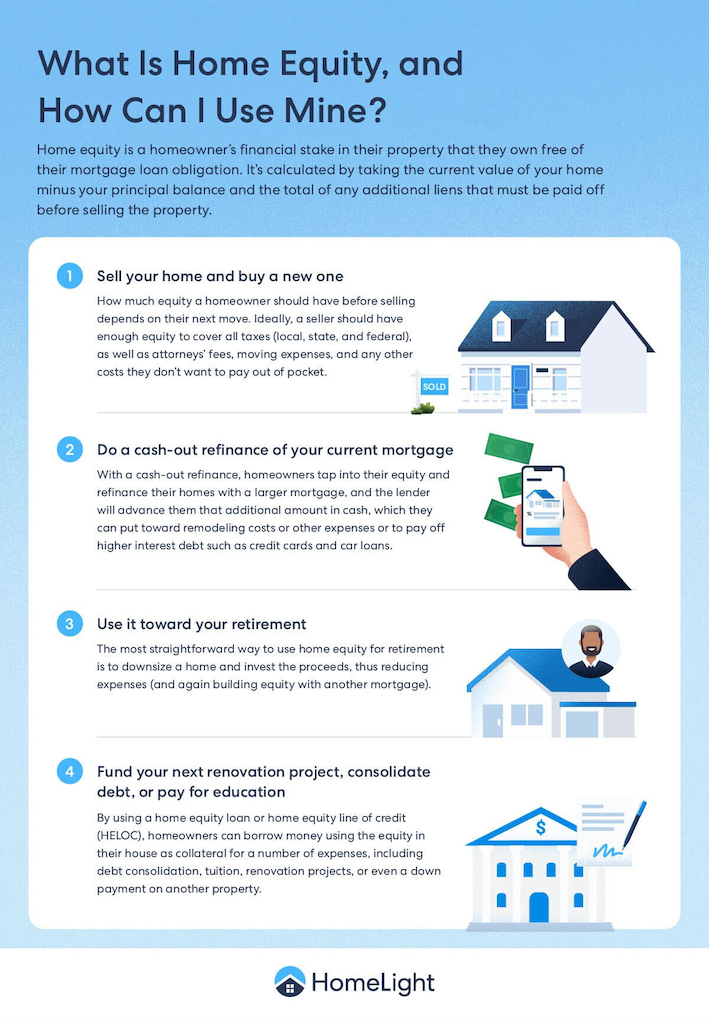
How can I use my home equity?
As you pay down your mortgage and your home value grows, the equity you build can give you more financial options. Many homeowners use their equity to help pay for important expenses, invest in their property, or achieve other long-term goals. As Joseph noted, building equity gives homeowners the peace of mind and stability that renters often don’t have.
Below, we’ll break down the different ways you can access your home equity and what to know before choosing an option.
1. Sell your home and buy a new one
How much equity you should have before selling depends on your next move.
Danny Freeman, a top-selling real estate agent in Memphis, Tennessee, suggests having 10% equity if you’re simply relocating and a minimum of 15% if you want a larger home.
“The more, the better” because your sale price needs to pay off the existing mortgage, cover closing costs, and handle at least a portion of the down payment on a new home.
Ideally, your equity should also be enough to cover all taxes (local, state, and federal), as well as attorneys’ fees, moving expenses, and any other costs you don’t want to pay out of pocket, Joseph adds.
To help you leverage your home equity to purchase a new home, consider using HomeLight’s Buy Before You Sell program. We’ll evaluate your existing property using a proprietary algorithm to determine how much of your home equity you can unlock to put toward the down payment on your new home, moving expenses, closing expenses, or property repairs. This allows you to make a contingency-free offer on a new home.
2. Do a cash-out refinance of your current mortgage
With a cash-out refinance, you can tap into your equity and refinance your home with a larger mortgage. The lender will advance you that additional amount in cash, which you can put toward remodeling costs or other expenses or to pay off higher-interest debt, such as credit cards and car loans.
Most lenders will limit your cash-out loan amount to 80% of your home’s value. What’s nice about this route is that a cash-out refinance is a standard first mortgage loan, not a secondary lien or line of credit, allowing you to take advantage of a mortgage’s lower interest rate compared to consumer debt.
3. Use it toward your retirement
The most straightforward way to use your home equity for retirement is to downsize your home and invest the proceeds, reducing your expenses (and again building equity with another mortgage). Reverse mortgages can help supplement your retirement income while tapping into your existing home equity, but this option can make it difficult to leave your home to your children, among other risks.
4. Fund your next renovation project, consolidate debt, or pay for education
A home equity loan or home equity line of credit (HELOC) allows you to borrow against the equity you’ve built in your home, using your property as collateral. You can use the funds for a variety of expenses, such as consolidating debt, paying for tuition, financing home renovations, or covering the down payment on another property.
The good news is that the interest you pay on a home equity loan may be tax-deductible if you use the funds to buy, build, or make significant improvements to the home securing the loan. However, if you use the money for other expenses, like paying off debt or covering personal costs, the interest may not qualify for a tax deduction.
Typically, you’ll need 15% to 20% equity in your home to qualify for a home equity loan, but be careful how you spend the money. You’ll have to pay back whatever you borrow, plus interest, for this option.
A Quick (And Free) Way to Check Your Home Value
Get a preliminary home value estimate in as little as two minutes. Our tool uses information from multiple sources to give you a range of value based on current market trends.
What are the risks of dipping into your home equity?
While it’s tempting to use your home equity to pay for home renovations, repairs, and other expenses, you could lose your home if you don’t repay what you’ve borrowed.
People unfortunately borrow against their house and then can’t pay it back, which makes it harder for them to sell. “A lot of people misuse the money,” Joseph says. “I know a lot of investors who do that. Buy a house, refinance, buy another house … but it’s not necessarily the best route to go. Or using the money for just anything, a car, for example.”
Even without borrowing against their home equity, homeowners can wind up with “negative equity,” or owing more on the mortgage than their home is worth. People also refer to this as being “upside down” or “underwater” on their mortgage. This can occur because of an increase in mortgage debt or a decline in home value.
If you’re thinking about using your home equity to cover debt or expenses unrelated to buying another property, it may be worth exploring other options first. Joseph recommends finding alternative ways to get the money you need or borrowing a smaller amount so you don’t put more of your home at risk than necessary.
Taking on a temporary job, cutting expenses, or using another type of loan designed for your specific needs may offer more financial flexibility without using your home as collateral.
What are some common misconceptions about home equity?
Myth: Home equity is “extra money” or liquid cash
Home equity may feel like money you have, but it isn’t the same as cash sitting in your bank account. It represents the portion of your home’s value that you own and can only be accessed through options like selling, refinancing, or taking out a loan against the property.
Using your equity also means taking on new financial obligations or giving up some of your ownership stake. It’s a valuable asset, but it’s not the same as having extra spending money available anytime.
Myth: Home values always appreciate
While many homes increase in value over time, appreciation is never guaranteed. Market conditions, interest rates, local demand, and the condition of your home can all affect whether its value rises or falls. Some homeowners may even see their property lose value during economic downturns or changes in their neighborhood. Building equity takes time and depends on more than just how long you own the home.
Myth: You can only use home equity for home improvements
Home equity can be used for many purposes, not just remodeling projects or repairs. Some homeowners use it to consolidate high-interest debt, cover major expenses, or fund other financial goals. However, because you’re borrowing against your home, it’s important to consider whether the expense is worth taking on additional debt. The best use of equity depends on your overall financial situation and long-term plans.
Myth: You automatically qualify to use your equity if you have enough
Having equity in your home does not automatically mean you’ll be approved for a home equity loan or line of credit. Lenders also consider factors like your income, credit score, existing debts, and ability to repay the loan. You may have significant equity but still not meet a lender’s requirements. Approval depends on your complete financial picture, not just how much of your home you own.
Myth: Only long-term homeowners can access equity
You don’t necessarily need to own your home for decades to build equity. Equity can grow when you make mortgage payments, especially as you pay down your loan balance, or when your home’s value increases. Some homeowners may build meaningful equity within just a few years, depending on their down payment, market conditions, and loan terms. How quickly you can access equity depends on how much equity you’ve built and whether you meet lender requirements.
With HomeLight Buy Before You Sell, you can make a strong, non-contingent offer on your new home without waiting to sell your current home. This modern bridge solution unlocks the equity in your existing property, streamlining the entire process so you win the home you want and move only once.Here's How You Can Buy Before You Sell
Home equity: The long game
Building home equity doesn’t happen overnight. It’s a long-term process that rewards patience, consistency, and smart financial decisions. Every mortgage payment you make, every improvement you add, and every increase in your home’s value can help you grow your stake in one of your biggest assets.
While home equity can give you valuable financial options, it’s important to understand how much you have and use it wisely. Whether you’re planning to renovate, pay for a major expense, or prepare for your next move, knowing your equity can help you make more informed choices.
Think of your home equity as a financial tool that grows alongside you over time, rather than a resource to tap into without careful planning.
“Real estate is a long game. It definitely, definitely pays off,” Joseph says. “Five years go by very fast. Even 15 or 20 years. Having a house and building equity over those years, even if you just own one property, can change someone’s life.”
In the end, the real value of homeownership isn’t just having a place to live. It’s building something that can support your financial goals for years to come.
Frequently asked questions (FAQs) about home equity
Most lenders typically want you to have at least 15% to 20% equity in your home before you can borrow against it. The exact amount depends on the lender, your credit score, income, and how much you still owe on your mortgage. Even if you qualify, you’ll usually only be able to borrow a portion of your available equity.
You can start using your home equity once you’ve built up enough of it and meet a lender’s requirements. This usually happens after you’ve paid down some of your mortgage or your home’s value has increased. How quickly you build equity depends on factors like your loan terms, payments, and the local housing market.
Home equity loan interest may be tax-deductible, but it depends on how you use the money. In general, the interest qualifies if you use the funds to buy, build, or make major improvements to the home securing the loan. If you use the money for things like paying off debt or personal expenses, it may not be deductible.
Yes, your home equity can decrease if your home’s value drops or if you take out loans that reduce the amount of equity you’ve built. For example, a declining housing market can lower your property value, which means you may have less equity than before. Making consistent mortgage payments and maintaining your home can help protect and grow your equity over time.
A home equity loan gives you a lump sum of money upfront that you pay back over time with fixed monthly payments. A HELOC, or home equity line of credit, works more like a credit card because you can borrow money as needed up to a set limit. The best option depends on whether you need one large amount of money or ongoing access to funds.
Header Image Source: (Alexander Wark / Unsplash)





 English (US) ·