
Selling your house can already feel like a lot to handle, and that pressure only grows when you’re racing against the clock. Whether you’re dealing with a death in the family, going through a divorce, or trying to catch up on mounting debt, the last thing you need is a drawn-out selling process. The good news is that you can still move forward with a fast, hassle-free transaction when you choose to sell house for cash and work with investors or house flippers ready to make an offer.
“You make a phone call or answer some questions online, agree to an offer, and then it’s not something you have to worry about anymore,” says Doug Van Soest, owner of SoCal Home Buyers, a house-flipping company in Southern California. “Plus, you’ll save money on things like commissions, repairs, and closing costs.”
Request a Cash Offer & Top Agent Value Estimate
Get a convenient, no-obligation all-cash offer to buy your home on your timeline. No repairs, staging, or showings — and close in as little as 7 days. You’ll also receive an expert estimate of what your home might sell for using a top-rated agent.
Although it’s a convenient option, selling a house for cash also usually means leaving some extra money on the table. So, is a cash transaction a good idea?
Here, we’ll take a closer look at what it means to sell your house for cash, how to weigh its pros and cons, where to request a cash offer, and ultimately, how to do it.
What does it mean to sell a house for cash?
When you sell a house for cash, it simply means you’re selling to a buyer who can purchase the home outright without the use of a mortgage loan. If you agree to an offer of $350,000, your cash buyer will need to show proof that they have that $350,000 at the ready in a bank account or its equivalent.
This usually means working with a specific type of buyer who looks for off-market homes, properties in poor condition, or houses they can buy at a lower price and improve.
Cash buyers make up a pretty big chunk of today’s housing market, according to the National Association of Realtors® (NAR). In June 2026, about 25% of home sales were paid for with cash. Many of these buyers are using money from previous home sales, which helps them skip higher mortgage rates and make their offers more competitive.
Even so, NAR’s 2025 Home Buyers and Sellers Generational Trends Report found that 74% of recent buyers used financing to purchase their homes. That means finding a buyer who can and wants to pay the full price in cash is still pretty rare.
Reasons to sell a property for cash
Now that you know what it means to get cash for your home, is selling your house for cash a good idea?
“The value a cash buyer offers is convenience and speed,” says Will Holly, owner of Holly Nance Group, a boutique real estate investment firm in New Jersey. “You’ll avoid the time hurdle involved with back-and-forth negotiations with multiple buyers.”
-

Mark Abdel Real Estate Agent
Mark Abdel Real Estate Agent at RE/MAX Advantage Plus
Currently accepting new clients
- Years of Experience 20
- Transactions 1366
- Average Price Point $371k
- Single Family Homes 1157

Let’s take a closer look at some of these benefits:
1. Faster closing
How long does it take for a cash buyer to close? When you sell a house for cash, you can get money for your home much faster, usually in a week or two, compared to a month and a half with a non-cash buyer.
Getting a mortgage can take some time, with the process usually lasting around 40 to 50 days from start to finish. Plus, lenders typically require an appraisal to decide how much they’re willing to lend, and that extra step can slow things down even more.
All in all, with a cash offer from a house-buying company, you can often close the sale in as few as 7 to 10 days. This is a huge advantage for sellers who need cash quickly.
2. No repairs or home staging
Most home buyers prefer a move-in-ready home that doesn’t require additional repairs or renovations. If your house needs work, it can be more challenging to find a traditional buyer.
When you sell your home for cash to a house-buying company, you can skip the repairs and other preparations typically required when selling on the open market.
Cash-for-homes companies often purchase homes as-is since they have the capital and expertise to update a house. This removes the repair burden from the seller’s shoulders.
A cash sale also means you won’t need to stage your home, worry about keeping it spotless for weeks, or disrupt your schedule for repeated showings.
3. Reduced closing fees
In addition to clearing away repair and staging expenses, a cash offer can eliminate extra closing costs. Many home-buying companies cover these costs entirely for the seller, which can total about 9% to 10% of the sale price.
The most significant expense is typically the agent commission, which averages 3% to 6% of the sale price.
These savings can offset a lower offer price, but it’s crucial to consider all fees and expenses when deciding whether to sell your house for cash.
4. Smaller holding costs
As long as you own a home, you’re on the hook for its holding costs (also called carrying costs), including things like utilities, property taxes, insurance, maintenance, and other expenses that can really add up each month.
In a slower real estate market, Holly says it can take up to six months to sell a house. That means homeowners may have to wait half a year to access their home equity while still paying for things like heating, cooling, lawn care, and other ongoing expenses.
A cash offer can help you stop paying these ongoing costs much sooner. Plus, the longer your home sits on the market, the more likely you’ll need to drop the price to attract buyers.
5. Peace of mind
Holly says a cash sale can give homeowners some much-needed peace of mind, especially when they’re already balancing major life changes or unexpected challenges. “Any home seller with any complexity to the sale is better off with a cash buyer,” he says. Those complexities might include a death in the family, bills stacking up, or expensive repairs.
A cash offer may come in lower, but it won’t hinge on your home appraising at a certain amount or the financing working out for your buyer. When you need cash now, a drawn-out sale can be a major stressor.
6. Interest rate immunity
For sellers, a cash buyer can feel like a safer bet because there’s no need to worry about a buyer’s loan falling through. With mortgage rates in the low-6% range, many buyers are facing higher borrowing costs, making cash offers stand out even more.
“A cash buyer is not susceptible to rate hikes,” Holly says. An increase in interest rates or a change in the buyer’s credit history or employment situation could cancel or delay a settlement just days before closing. “Contracts are falling out more often,” adds Holly about the current real estate market.
Without a mortgage contingency to worry about, selling to a cash buyer is usually a simpler process with fewer surprises along the way.
7. Flexible timelines
A cash sale can also make the moving process much easier to manage. Instead of working around a buyer’s timeline or waiting on loan approvals, you can choose a closing date that fits your schedule. This flexibility can be especially helpful if you need extra time to find your next home, coordinate a move, or handle other life changes.
Many house-buying companies allow sellers to pick a move-out date that works best for them, whether that means leaving quickly or staying in the home for a little longer. Having more control over the timeline can take away some of the stress that often comes with selling a house.
What’s the process of selling a house for cash?
Selling a home for cash skips many of the traditional steps, making the process faster and more straightforward. There’s no need for mortgage approvals, appraisals, or extensive repairs.
Here’s a simple breakdown of how a typical cash sale works.
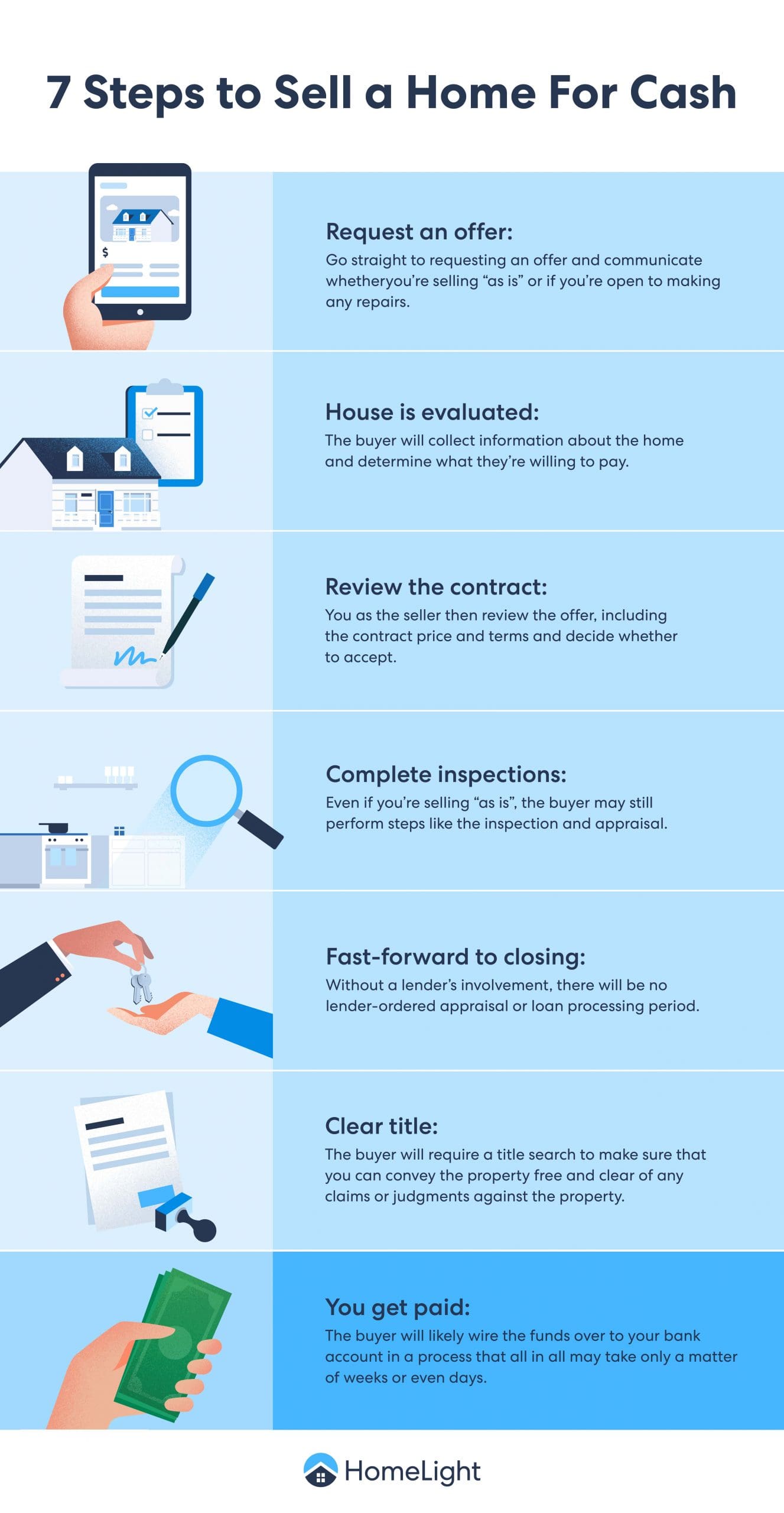
Step 1: Request an offer. Go straight to requesting an offer and communicate whether you’re selling “as is” or if you’re open to making any repairs.
Step 2: Schedule a property evaluation. The buyer will collect information about the home and determine what they’re willing to pay.
Step 3: Review the contract. Review the offer, including the contract price and terms, and decide whether to accept.
Step 4: Complete inspections. Even if you’re selling “as is”, the buyer may still perform steps like the inspection.
Step 5: Fast-forward to closing. Without a lender’s involvement, there will be no lender-ordered appraisal or loan processing period.
Step 6: Clear title. The buyer will require a title search to make sure that you can convey the property free and clear of any claims or judgments against the property.
Step 7: Receive payment. The buyer will typically wire the funds directly to your bank account at closing, and the entire process can often be completed in just a few weeks or even a matter of days.
When selling your home, one of the biggest decisions is whether to go the traditional route or accept a cash offer. Each option has its own pros and cons, depending on your priorities, speed, convenience, or the potential for higher profit.
Here’s how a cash home sale compares to a traditional one.
Cash home sales vs. traditional home sales
| Aspect of the sale | Selling the house to a cash buyer | Listing with a real estate agent |
| Timeline | In as little as 7 days or up to 30 days if the seller needs more time | 68 to 78 days (28 days to get an offer, and another 40 to 50 days to close, on average) |
| Home prep and repairs | None. You skip the preparations, repairs, and staging. | Make necessary repairs, deep clean, declutter, landscape, and stage the home. |
| Showings | There are typically no showings, though a cash buyer will collect information about the home and may request photos or videos. | You’ll make your home available for 10 to 25 showings, on average. |
| Inspections | Some house-buying companies require a home inspection, while others waive it. | You may need to make repairs for the buyer or renegotiate the price after the inspection. |
| Appraisal | House-buying companies and investors may or may not perform a traditional appraisal, depending on the on-site visit and the company’s evaluation process. | When your buyer secures a mortgage, an independent appraisal will be required to close. This process can take six to 20 days and may require negotiations. |
| Title search | The cash buyer will require a title search to make sure that you can convey the property free and clear of any claims or judgments against the home. | Title issues must be resolved to close the sale. The property must be clear of claims, such as mechanics’ liens, unpaid taxes, or boundary encroachments. |
| Financing contingency | Most cash buyers don’t have these contingencies since they have ready funds for the transaction. | Mortgaged buyers often use a financing contingency that could hold up the deal if the loan doesn’t clear. |
| Closing costs | Many cash-for-homes companies will pay the closing costs. | About 1% to 3% of the sale price (on top of the agent’s commission), including title insurance, escrow fees, and taxes. |
| Payment | The cash buyer may wire funds to your bank account in weeks or even days. | The time it takes for you to receive funds will depend on the buyer’s due diligence period and other steps you must clear before settlement, as required by the buyer’s lender. On average, it takes about 40 to 50 days to close a traditional home sale. |
Who buys houses for cash?
Cash buyers are individuals or businesses that buy homes directly with cash, usually in as-is condition without needing a mortgage. Selling this way can help you avoid the hassle of repairs, showings, and staging while giving you more control over when you move and close.
Just remember that not all cash buyers operate the same way, so it’s worth knowing who you’re working with before moving forward with an offer. To keep it simple, we’ve grouped these buyers into a few broader categories you’re likely to encounter.
Investors
Investors are cash buyers who purchase homes as a way to grow their wealth. Some investors buy properties, make improvements, and sell them for a profit, while others hold onto them and earn income by renting them out. Since they often use their own funds instead of getting a mortgage, they can usually make cash offers and close faster.
Buy-and-hold cash buyers purchase homes and convert them into rental properties. They may sell a property once it appreciates enough or keep it indefinitely.
This category includes individual investors who buy and rent out properties for passive income and larger institutional investors. When you sell to a buy-and-hold investor, you have more flexible closing dates and will likely get a better price than if you were to sell to a house flipper.
House flippers are buyers who purchase homes that usually need some work, fix them up, and then sell them for a profit. They often look for houses they can improve quickly, whether it’s through repairs or renovations that make the home more appealing to buyers.
Home flippers remain a strong force in the cash house-buying marketplace. They bought and resold over 64,000 single-family homes and condos during the first quarter of 2026. This shows just how active flippers continue to be in the housing market, looking for properties they can renovate and turn into profitable investments.
We Buy Houses and large scale house-buyers
Large-scale house buyers specialize in purchasing homes quickly for cash, often in as-is condition. These companies offer a hassle-free sale with no repairs needed. Sellers typically start by submitting property details online or calling for an offer. While the process is fast and convenient, the offers are generally below market value.
You’ve probably seen ads for companies saying, “We Buy Houses for Cash.” These companies fall into the house flippers category listed above, but are worthy of their own category because of their growing prominence in the industry.
The largest house-buying franchise in the country is HomeVestors of America, which operates under the name “We Buy Ugly Houses®” and specializes in flipping dilapidated homes.
It’s easy to confuse We Buy Ugly Houses with other companies that have similar names touting their cash house-buying capabilities, such as We Buy Houses, another large, legit house-buying group. But keep in mind that “We Buy Houses” is not a trademarked term.
Many companies, big and small, use this phrase in their business name. Don’t assume “We Buy Houses” to be an indicator of a company’s legitimacy.
iBuyers
An iBuyer or instant buyer is a specific type of house-buying company that first emerged in the mid-2010s. They use automated valuation models (AVMs) to make competitive offers on homes that are typically in better condition. Examples include Opendoor and Offerpad.
While iBuyers generally pay more for homes than flippers or buy-and-hold investors, they charge a service fee of about 5% of the home’s sale price. Because they make smaller profits on each home, iBuyers focus on buying and selling a large number of properties and use technology to make the process faster and more efficient.
Launched in 2014, Opendoor is considered the nation’s pioneering iBuying platform. It purchases homes directly from sellers who submit property information online. It presents a no-obligation offer in minutes.
The company accommodates properties in various conditions, though certain factors like a short sale, unpermitted additions, major foundation issues, flood damage or fire damage, or dated materials may affect the company’s decision to buy a home.
Founded in 2015, Offerpad is one of the largest iBuyers by transaction volume, along with Opendoor. Sellers can get started with the sale transaction by providing information about their property through a questionnaire.
After checking the home’s condition, the company presents a competitive offer within 24 hours, which you can accept or decline. If you’re moving locally (within 80 miles), Offerpad will pay a professional moving company to haul your furniture and belongings to your new home.
How to find reputable cash buyers
One of the easiest ways to find a trustworthy cash buyer is through a platform like HomeLight’s Simple Sale. It connects you with a network of cash buyers and gives you a no-obligation cash offer, so you can explore your options without any pressure. The investors in its network use different strategies, from fixing up homes and renting them out to buying and holding properties long term.
To get started, tell us a few details about your home and when you need to sell. After collecting some information, we’ll provide you with a no-obligation, full cash offer in as little as 24 hours, and you can close in as few as 7 days.
What are the downsides of selling for cash?
Although a cash sale can make the selling process much easier, it’s important to know its biggest downside: getting a lower offer than you would by listing your home on the open market.
House-buying companies typically pay less for your home because they need to factor in the cost of repairs, renovations, and other expenses after they purchase the home. They’ll do a walkthrough to see what kind of work the property needs, then use that information to decide how much they’re willing to pay. We’ll talk more about this in the next section.
When flipping a house, “everything has to look brand new after repairs,” Holly says. Sometimes, this involves gutting the entire house, while other times, it’s just a cosmetic makeover. Turnaround time is typically about four months from the time he buys a home, makes renovations, and then sells it.
Depending on your situation, getting a lower cash offer may not be a big deal, or it could make you lean toward a traditional home sale instead. When you list on the open market, you may have a better chance of getting a higher price because buyers can picture themselves living in the home and may feel more emotionally connected to it.
With cash buyers, though, the decision usually comes down to the numbers. It’s more about the investment than the personal connection.
A lower sale price isn’t the only trade-off when selling for cash. Here are a few other potential drawbacks to consider:
- Fewer buyers: Since cash sales are limited to buyers who can pay for a home upfront without financing, you’ll have a smaller pool of potential buyers to choose from.
- Limited bargaining power: Most house-buying companies dictate the terms of the sale. Since you’re usually working with one buyer instead of multiple interested buyers, you may have less leverage when negotiating the price, closing date, or other terms.
- Unreliable buyer: Not every cash buyer is reputable, so it’s important to ask for a proof-of-funds letter to ensure they can follow through on the deal.
- Less competition for your home: Unlike a traditional listing where multiple offers may come, a cash sale usually involves one buyer and one offer.
How much do cash home buyers pay?
As mentioned earlier, cash buyers usually offer less than what you might get on the open market. But how much less? And more importantly, how much do you lose when you sell your house for cash?
There’s no one-size-fits-all answer: different house-buying companies and investors will come up with different offers based on things like your home’s condition, price, and location.
Most investors have what’s called a “buy box,” which is basically a list of the types of homes they’re looking for. So even if two buyers can both pay cash, they may see the value of your home differently depending on whether it fits what they’re trying to buy.
- Flippers often use the 70% rule. According to this guideline, a flipper won’t pay more than 70% of the “after-repair value” (ARV) of a home, which accounts for deductions to make repairs and renovations.
- iBuyers tend to pay closer to market value because they target newer homes in good condition. But they charge a service fee, about 5% of the sale price. You’ll likely pay closing costs, between 1% and 2% of the sale price, for escrow fees, title fees, and transfer taxes. After you accept the iBuyer’s offer, the company then inspects the home and subtracts the estimated cost of repairs from the final price.
- Buy-and-hold investors fall somewhere between flippers and iBuyers. They typically pay more than flippers but less than iBuyers and aim to make between 8% and 12% on their investment when they sell or 4% to 10% from rental income while they hold.
“The minimum return on investment varies, depending on things like the market and the condition of the home, but typically we need at least a 10% return on a purchase to make it worth the risk,” Van Soest explains.
Ultimately, the offer you receive can depend on several factors, including your home’s condition, location, and how much work a buyer expects to put into it.
“The discounted price someone should expect for a cash sale varies significantly,” Van Soest says. “The cleaner the house, the better the neighborhood, and the fewer issues a house has, the more likely you’ll get an offer that’s closer to market value. The more problems the buyer has to deal with, the lower the offer will be.”
Cash buyers may offer different amounts depending on your home’s condition, location, and potential, so having a baseline value is important. Get a preliminary estimate of how much your home might be worth today with HomeLight’s Home Value Estimator.
Answer a few questions about the home you’d like to sell, and we’ll use local housing market data to give you a ballpark value estimate in less than two minutes. A top real estate agent can also be a helpful resource in making your decision.
What's your home worth today?
Tell us a little bit about your property and get a preliminary estimate of value in as little as two minutes.
»Learn more: Wondering if a cash offer is actually worth it? Use the Home Cash Offer Comparison Calculator to see how different cash offers from various buyers stack up and get a better idea of what you could walk away with.
Are cash-for-homes companies legit?
The short answer is yes. Many cash home-buying companies are legitimate businesses that purchase homes directly, provide a smooth selling experience, and follow through on their offers. That said, it’s still a good idea to do your homework before sharing personal information or signing any paperwork to make sure you’re working with a reputable buyer.
“Check that the house-buying company has a good track record of homes purchased,” Holly advises. He suggests looking at properties that the firm bought and sold in your neighborhood and examining public records to review its transaction history.
In addition, request references from other home sellers who have sold to the investor or house-buying company. Call them to ask about their experiences.
Mark Abdel, a top-performing real estate agent in Minneapolis who sells properties 66% faster than the average agent in his market, cautions sellers to be wary of scams where house-buying companies promise a certain price but then hit you with hidden fees that substantially slash your profit. Other steps to help ensure a company is legitimate include:
- Check their Better Business Bureau (BBB) rating: No matter what type of house-buying company you decide to work with, make sure it’s an accredited BBB member. Check for positive reviews and timely responses to complaints. HomeLight, which provides cash offers for homes through the Simple Sale platform, has been BBB-accredited since 2019 and currently maintains an A+ rating.
- Ask for proof of funds and adequate earnest money: “Ask for proof of funds, such as a bank letter, to make sure they have the money in their account,” Holly advises. A proof of funds (POF) letter from the buyer’s bank shows that they have enough cash available to cover the home’s purchase price, closing costs, and any required earnest money deposit. This deposit is basically a buyer’s way of showing they’re serious about moving forward with the sale.
Should I still use a real estate agent?
An established real estate agent will likely know who’s who in the local cash-buyer market and can also help you avoid getting lowballed.
“A lot of agents that are experienced and have been in the business have a Rolodex of people [who] they’ve worked with over time [and] are investors,” Abdel says, commenting on how top agents can help find cash buyers by pitching properties to their networks.
“There are a lot of investors reaching out directly to homeowners to try and buy their property with cash,” notes Brian Breeckner, a top-selling real estate agent based in Columbus, Ohio, who has helped investors build their portfolios.
“To make sure a buyer is legitimate, or that they’re making a good offer based on the value of your home, you can always speak to an experienced local real estate agent and get their opinion,” he advises.
HomeLight can connect you to top-performing agents in your area who sell homes faster and for more money. We analyze more than 27 million transactions and thousands of reviews to determine which agents will best meet your needs.
Whether you want to sell for cash or get your home in front of more buyers by listing it, you can get matched with agent recommendations in just two minutes.
FAQs on selling house for cash
Selling your house for cash can be a good idea, depending on your specific circumstances and needs. Some potential advantages include speeding up the sale process, avoiding the complexities of financing and appraisals, and receiving the full payment upfront without delays.
However, it’s important to carefully consider the offered price, research the reputation of cash buyers or companies, and evaluate your long-term financial goals before making a decision. Consulting with a real estate professional recommended by HomeLight can help you assess whether selling for cash aligns with your situation.
No, selling a house for cash is totally legal. It just means the buyer pays upfront without needing a mortgage loan. As long as everything is properly documented and follows local real estate laws, you’re good to go.
You can start by reaching out to cash home-buying companies, investors, or marketplaces that connect sellers with cash buyers. Many companies let you submit property details online and get an offer within hours or days. Just make sure to research the buyer and read reviews to avoid scams.
Stick with reputable companies or buyers who have verified reviews and a solid online presence. Be cautious of anyone who pressures you to rush, won’t meet in person, or asks for upfront fees.
It depends on your situation. Investors usually buy as-is and close fast, but their offers are often lower. Traditional cash buyers could offer more and may not require an appraisal, but they may arrange for inspections, which can extend the selling timeline.
If you’re looking for maximum profit, listing your home on the open market with a real estate agent is usually the best move. This way, multiple buyers can bid, potentially driving up the price. Selling for cash is faster, but you might get a lower offer compared to selling traditionally.
It’s not always required, but it’s a smart move. A lawyer can help you review the contract, ensure a smooth closing, and protect you from potential legal issues. If you’re selling on your own without a realtor, having legal guidance is even more important.
Technically, yes. You can sell your house for any amount you choose. However, if the price is significantly below market value, it could lead to tax implications, such as the gift tax, which is common among those selling to a family member at a discount. It’s always best to consult a professional before making such a low sale.
Should you sell your house for cash?
One thing is certain: Companies that buy homes for cash aren’t going anywhere. And they are becoming more popular with a variety of sellers, not just those in distress.
“In my opinion, iBuyers and other cash-buying companies will continue to become more mainstream,” Van Soest says. “Technology is making it easier and easier to sell a home virtually.” And, he adds, you may get a better price than you would expect if your house is in really good condition and in a desirable area.
If speed, convenience, and certainty are your top priorities, then selling your house for cash can be the right choice for you. Abdel sums it up: “It’s an almost guaranteed sale where you go with the cash buyer, and you don’t have any contingencies.”
With a cash buyer, you don’t have to worry about mortgage delays or financing falling through at the last minute, so you can usually close much faster and with a lot less stress. The trade-off is that you’ll likely get a lower offer, especially if you’re selling to an investor instead of someone who plans to live in the home. For many sellers, though, the speed and convenience are well worth it.
Still on the fence? HomeLight’s Simple Sale platform offers a commitment-free way to test the waters. We partner with one of the largest networks of cash buyers in the U.S. Just enter a few details about your home online, and we’ll provide you with a cash offer within 24 hours. You can close the sale in as few as 7 days, no additional fees, agent commission, or prep work.
Writer Dorothy O’Donnell contributed to this story.
Header Image Source: (Will Porada/ Unsplash)





 English (US) ·