
Buying land can feel like a different world compared to buying a traditional home. Without walls, rooms, or a finished structure to judge, it can be tricky to know if a property is actually worth the asking price. That’s where land appraisals come in, helping buyers understand a property’s true market value before making an offer.
An appraisal can reveal important details about the land’s location, potential uses, and any factors that could affect its value. Whether you’re planning to build a dream home, invest, or hold onto the property for the future, knowing what you’re buying is key. In this guide, we’ll break down how land appraisals work and what buyers should look for before closing the deal.
Find an Agent Who Knows Land Value
A land appraisal can tell you what a property is worth, but a local expert can help you understand whether it’s truly the right investment. Connect with a trusted real estate agent through HomeLight to get guidance on land purchases, market trends, and finding a property that fits your goals.
How does a land appraisal work?
A land appraisal may sound complicated, but the process is pretty straightforward. An appraiser’s job is to take a close look at the property, gather information, and determine a fair market value based on their findings. Here’s what the process usually looks like:
- The appraiser reviews the property details: The appraiser starts by gathering basic information about the land, such as its address, size, ownership details, and any available documents related to the property.
- The appraiser visits the property: Next, the appraiser conducts an on-site inspection to get a firsthand look at the land. They’ll take notes, measurements, and photos to document the property and its current condition.
- The appraiser researches comparable land sales: The appraiser looks at similar properties that have recently sold nearby to help estimate the land’s market value. These comparable sales, or “comps,” provide a helpful benchmark for the appraisal.
- The appraiser analyzes the information collected: After gathering all the details, the appraiser reviews the property data, sales comparisons, and other research to determine an appropriate value.
- The appraiser prepares the final report: Finally, the appraiser puts everything together in a written report that explains their findings and the estimated value of the land.
What factors influence land appraisals?
A plot of empty land can be worth much more than it appears at first glance. While you might just see a patch of grass or a vacant property, an experienced land appraiser sees the bigger picture, like its location near a growing community, the quality of its soil for farming, or its potential for future development. All of these details can play a major role in determining what the land is really worth.
Compared to appraising an existing home, valuing raw land can be a bit more complicated. A standard land appraisal report shows just how many factors an appraiser needs to consider, weigh, and compare before determining a property’s final value. So, what exactly goes into a land appraisal? Let’s look at some of the key factors that can influence a property’s value:
Sales comps
Finding comparable properties for vacant land can be a little trickier than finding comps for homes since there are usually fewer land sales to compare. Still, a land appraiser will look for recently sold parcels that are similar to the piece of land you’re looking at, taking into account its size, location, and intended use to get a baseline for the property’s value.
Land comps can be found through several online databases. For example, the Lands of America Comparable Sales Program provides data on land transactions that can be useful for buyers, sellers, and real estate professionals like appraisers.
Once the appraiser reviews comparable sales, they’ll adjust the value based on the unique features and characteristics of your property.
‘Highest and best use’
When appraising undeveloped land, an appraiser’s goal is to determine the property’s “highest and best use,” or the most valuable and realistic way the land could be used. This means considering whether a potential use is legally allowed, physically possible, financially practical, and likely to bring the greatest value to the property.
Put simply, the question is: What’s the best way to use this land to get the most value out of it?
For example, if the property is a typical rectangular lot in a residential neighborhood, the most profitable option may be building a home that fits in with the surrounding properties.
On the other hand, a large parcel in a busy commercial area could be worth more as a shopping center, office space, or entertainment venue. For land in a rural setting, turning it into farmland or using it for another agricultural purpose may be the option that creates the most value.
Erik Pogwist, the chief appraiser of Incenter Appraisal Management, a national company that provides valuation, inspection, and data solutions for lenders across the country, regularly performs land valuations. He explains:
“Value increases based on what you can use the land for. Therefore, an appraiser must be able to recognize the utility of the parcel to be able to properly value the site.”
To determine whether the owner’s use of land qualifies as “highest and best use,” appraisers run four different tests:
- Is the use legally permissible? Are there any zoning requirements that would limit how the land can be used? For example, if the buyer wants to put in a nursing home or a department store, would those uses be allowed?
- Is the use physically possible? Appraisers consider things like the land’s size, shape, terrain, and access to make sure it can support what the buyer or owner has in mind. For example, a narrow, hilly parcel with limited road access probably wouldn’t be the best fit for someone hoping to build a waterpark or racetrack.
- Is the use financially feasible? Appraisers also look at whether the property fits in with the surrounding area or if it could become an over-improvement that costs more than buyers are willing to pay. For example, building a massive luxury home with high-end finishes on a street filled with modest ranch houses may not be the smartest investment.
- Is the use most profitable? For commercial properties, appraisers look at what type of development could generate the highest income based on nearby businesses, surrounding buildings, and local demand. For example, building a second movie theater in an area that already has one may not be as profitable as developing a shopping center where the community has a strong need for more retail options.
NAR’s Land Market Survey breaks down the average percent change in land prices by different land types and uses:
- Residential: +1.6%
- Industrial: +1.9%
- Recreational: +1.9%
- Agricultural, irrigated: +1.2%
- Agricultural, non-irrigated: +0.8%
- Ranch: +2.2%
- Commercial: +1.7%
- Timber: +1.3%
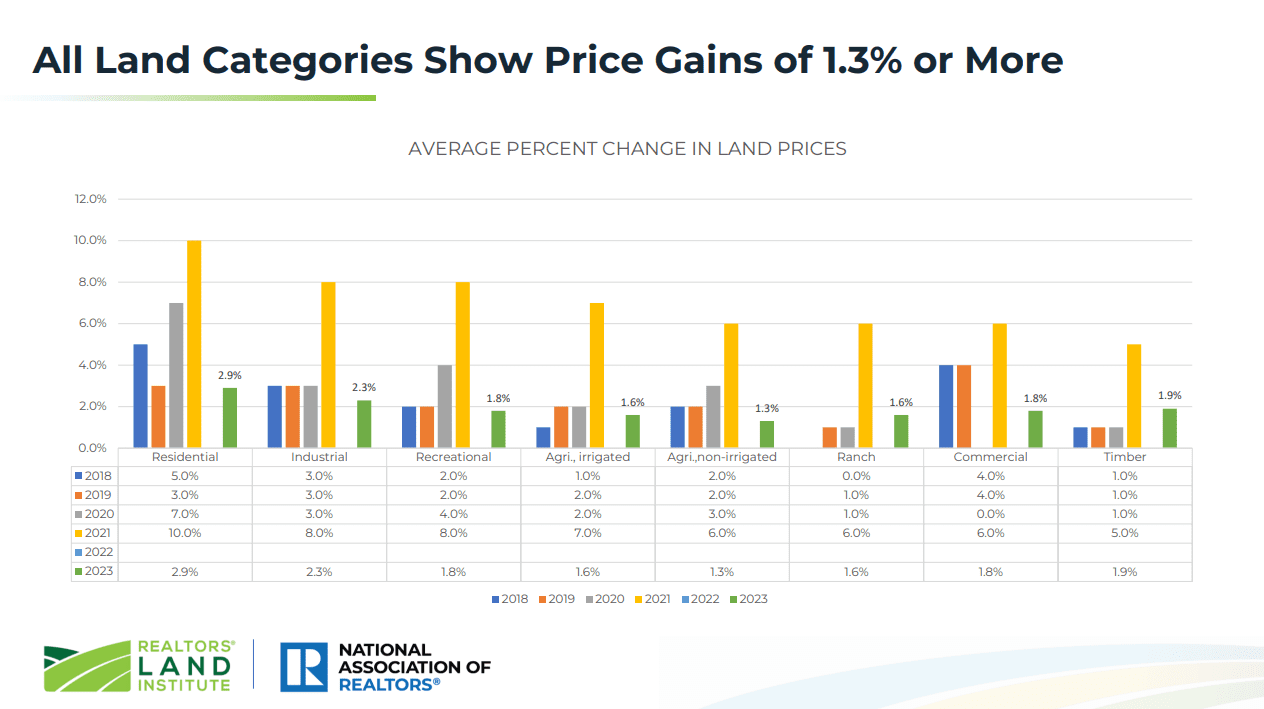
Source: 2025 Land Market Survey
Size and shape
It’s easy to assume that if one acre of land is worth $50,000, then four acres must be worth $200,000. But land doesn’t always work that way.
As a parcel gets larger, the value per acre often decreases, a concept economists call the “law of diminishing returns.” Think of it like buying in bulk at the grocery store: the bigger package usually comes with a lower price per unit than the smaller one. The same idea applies when valuing larger parcels of land.
The shape of a piece of land can make a big difference in how it’s used and how much it’s worth. An oddly shaped lot may not be as appealing because it can limit building options or create less desirable layouts.
For example, imagine a pie-shaped lot that’s wider at the front than at the back. A home built there would likely have more yard space in the front and less room behind the house, which may not appeal to buyers who value a private backyard.
Irregular or triangular lots can also be trickier to develop because they may limit the size and layout of the building that can be built on the property. These limitations can make the land less attractive and potentially lower its value.
Accessibility
One of the biggest drivers of a piece of land’s value is the amount of frontage, which refers to how much of it is accessible by road. Particularly if you’re selling a larger tract of land that will be subdivided, each municipality may have specific zoning rules that dictate how much road frontage each lot must have, explains Melanie Hunt, a top Fort Worth, Texas, real estate agent who often sells vacant land.
“The more road frontage and the more acres the road touches, the higher the land value will be,” says Hunt. “For example, if there are 500 feet of road frontage and the land is very narrow and deep and hard to build on, the back acres won’t be worth nearly as much. But a large corner lot with lots of frontage will have much more value.”
Utilities
Utilities can have a big impact on a piece of land’s value. A land appraiser will look at whether the property already has access to essentials like water, sewer, and electricity.
If those connections aren’t available, the buyer may need to pay to bring them in, a project that can cost anywhere from $100 to $60,000 or more and may take months to complete due to permits and construction work. In some cases, a developer may be able to install alternatives, like a septic system or private well, but those options can still come with a hefty price tag.
As Hunt explains, having power, water, and sewer access already available at the property line can significantly increase the land’s value.
Topography
The topography, or geographical makeup, of a piece of land can have a big impact on its value. For example, swampy land won’t be suitable for building a home, but a buyer might want it for recreational purposes. An appraiser will examine the land’s physical features, including the presence of mountains, steep grades, rivers, lakes, and valleys, as a means of determining its use potential.
Amenities
In the same way that a built home can be more appealing when it has a pool, a great view, or a peaceful location, land can also have features that make it stand out. Factors like lake access, a private fishing pond, scenic views, hiking trails, or other natural perks can add value to a property. An appraiser will consider these features as long as they enhance the land without making it harder to use or develop.
Zoning
Most land is subject to zoning rules, which determine what you can and can’t do with a property. These regulations can affect everything from the type of building you can construct to how the land can be used, making them an important factor in determining its value. Some of the most common types of land zoning include:
- Single-family residential
- Multi-unit residential
- Light industrial
- Commercial
- Light commercial
- Agricultural
- Schools
Beyond what type of building can be constructed, zoning laws can also control specific construction details, like the height of structures. The appraiser will consider the zoning when determining the valuation. If the laws are restrictive, they could potentially deter would-be buyers.
Flood risk
Flood risk is another important factor that can affect a piece of land’s value. If a property sits in a flood-prone area, an appraiser will consider things like the likelihood of flooding, how severe past floods have been, and which parts of the land may be most vulnerable.
A higher flood risk can make the property less appealing because it may come with extra costs, building restrictions, or challenges with development, all of which can lower its value.
Environment
Hunt says buyers will usually order an environmental study before closing because the findings need to be included in the appraisal. Things like hazardous materials or contaminants in the soil, including pesticides, radon, lead, or asbestos, can significantly reduce a property’s value.
Appraisers will also take into account environmental factors like wetlands, protected wildlife, or endangered species, since they may limit how the land can be developed.
Rural vs. residential
Many landowners possess vacant lots that will someday become the site of a house or building. But appraisers will treat rural tracts of land or farmland used for agricultural purposes differently than they do residential or commercial land.
“Rural appraisals can be more challenging due to the lack of sales data, which is naturally the result of having many fewer homes than in suburban or urban markets,” explains Pogwist.
“In some rural counties, there may not be sales for many months or even years. The appraiser would need to expand his or her comparable sale search far beyond what is typical in order to find sales that could be utilized as value indicators for a property.”
The appraiser will consider some of the same factors, such as access, topography, and configuration, but the size of rural land is often much larger, adding extra time and cost to the valuation process. The value will also hinge on things like the farm economy, the quality of the soil, irrigation and drainage, the local climate and rainfall, and any current farming regulations that might limit usage of the land.
The portion of usable space is one of the key factors in farmland appraisals. As Hunt explains: “If you have 100 acres of land, and 50 of it is usable, and the other 50 is comprised of gullies and trees that can’t be plowed or cultivated or grazed, the value of the usable acres will be much higher than the rest.”
Local demand
Pogwist says he often sees buyers offer more than the appraised value of vacant land, especially when they see potential for future income that the appraiser may not factor in. This can also happen when multiple buyers are competing for the same piece of land and driving up the price.
“An appraisal is nothing more than an expert’s opinion, based on experience, sound data, and thoughtful analysis,” he says. “Someone may have the need, desire, and resources to pay more, and the seller would likely be quite happy to sell for more.”
In Hunt’s experience, about 25% of buyers end up offering more than the appraised value, especially when the property is unique or has a specific use that makes it more valuable to them than the typical market value suggests. If the buyer is using a mortgage to fund the purchase, they’ll need to cover the difference themselves by bringing extra cash to closing to make up for the gap between the loan amount and the purchase price.
»Learn more: Lenders usually require 20% to 50% down for land purchases because vacant land can be harder to sell if a borrower defaults. Before you start picturing your dream property, figure out what it’ll take to make it yours. Use a Down Payment Calculator to crunch the numbers, plan your budget, and see how close you are to breaking ground.
When is a land appraisal needed?
A land appraisal can come in handy whenever you need a clear idea of what a piece of property is worth. Whether you’re buying, financing, or making plans for the future, an appraisal can help you make a more informed decision.
- When you’re buying vacant land: Before making an offer, a land appraisal can help you understand whether the asking price matches the property’s market value. It gives you more confidence that you’re making a smart investment.
- When you’re getting a land loan: Lenders often require an appraisal before approving financing for a land purchase. The appraisal helps them determine whether the property provides enough value to secure the loan.
- When you’re planning to build on the land: If you’re buying a lot for a future home or development project, an appraisal can help you understand the property’s value before putting more money into construction plans.
- When you’re dividing or selling part of a property: If you’re splitting a larger parcel, selling a portion of your land, or settling ownership matters, an appraisal can help determine a fair value for the property.
- When you’re settling an estate or handling a legal matter: A land appraisal may be needed to determine the property’s value for estate planning, inheritance purposes, or other situations where an accurate valuation is required.
A land appraisal isn’t something buyers need for every transaction, but it can be a valuable tool when a property’s value isn’t immediately clear. By getting an expert opinion, you can move forward with a better understanding of what you’re buying and whether the land is worth the investment.
Why land appraisals are tough to get right
Not all residential appraisers have the experience and expertise to appraise land. Choosing an appraiser who doesn’t specialize in this area can be a recipe for disaster.
In one example cited by LIA Administrators & Insurance Services, a land buyer used an Arizona appraiser to find out what a two-acre parcel was worth.
The appraisal pegged the value at $160,000, and the buyer secured funds from a lender to finance the land purchase. When the buyer later defaulted on the loan and a foreclosure was filed, the lender hired a different appraiser to give the land another look.
The new appraiser found that there was no access to the lot and assigned it a value of just $90,000, $70,000 less than the first appraised amount. The lender then filed a lawsuit against the first appraiser, who should have recognized the fact that those two acres were landlocked.
Search for a reliable professional: To find a licensed and qualified land appraiser, start by asking a local real estate agent who specializes in land transactions for recommendations. An agent like Hunt, for example, will have a direct referral for you, saving you time in your search for an appraiser you can trust.
You can also search the American Society of Farm Managers and Rural Appraisers, where you can find the contact information of more than 2,100 of the country’s top land appraisal experts.
Land appraisals look to the future
Buying land is about more than just purchasing a piece of property. It’s about understanding what that property could become. Whether you’re dreaming of building a home, starting a business, creating a farm, or simply investing for the future, a land appraisal helps reveal the possibilities while giving you a clearer idea of what the property is truly worth.
Unlike a home appraisal, which focuses on an existing structure, a land appraisal looks beyond what’s there today and considers the potential of what could come next. With the right information and guidance, you can make a more confident decision before investing in a piece of land.
Turn Land Potential Into a Smart Purchase
A piece of land may look like a blank slate, but knowing what it’s worth and what you can do with it takes the right expertise. Partner with a HomeLight agent who can help you navigate land appraisals, evaluate opportunities, and make a confident offer.
A local real estate agent can help you find promising land opportunities and navigate the buying process from start to finish. Use HomeLight to connect with a trusted agent who understands your market and can help you find the right property for your goals.
Frequently asked questions (FAQs) about land appraisals
Not every land purchase requires an appraisal, but many lenders require one before approving a land loan. An appraisal helps the lender confirm that the property is worth the amount being financed. Even if it’s not required, getting an appraisal can still help buyers make sure they’re paying a fair price.
A land appraisal usually takes anywhere from a few days to a few weeks, depending on the property’s size, location, and complexity. The on-site inspection itself may only take a few hours, but the appraiser will need additional time to research comparable sales, review property details, and analyze the data.
After completing their research, the appraiser typically spends a few more days preparing the final report. Larger or more unique parcels may take longer since they often require more in-depth research, but most land appraisals are completed within two to four weeks.
A land appraisal typically costs $1,000 to $6,000, depending on the property’s size, location, and complexity. A small, easy-to-evaluate parcel may cost less, while a large tract of land with unique features may require more time and research. It’s a good idea to ask for a quote upfront so you know what to expect.
Yes, a land’s appraised value can change as market conditions, nearby development, and demand shift over time. A property that’s worth one amount today may be valued differently a few years from now. If you’re making a major decision, like buying or refinancing, it’s usually best to rely on a recent appraisal.
A land survey and a land appraisal serve two different purposes. A survey focuses on the physical details of the property, like its boundaries, measurements, and any encroachments, while an appraisal determines how much the land is worth. In simple terms, a survey tells you what the property is, and an appraisal tells you what it’s worth.
Header Image Source: (Nokwan007 / ShutterStock)




 English (US) ·