
TL;DR: Mashvisor’s API gives developers unified access to property data, STR/LTR analytics, comps, AVM valuations, MLS-style marketplace listings, and historical Airbnb performance. All endpoints return structured JSON for underwriting, deal screening, forecasting, and portfolio-level automation.
Evaluating real estate performance requires more than scattered spreadsheets, manually scraped listings, or incomplete market reports. Developers, investors, and PropTech builders need clean, structured, machine-ready data that they can plug directly into underwriting models, forecasting engines, and automated investment tools.
That’s exactly what the Mashvisor API delivers: A unified real estate data interface that brings together property data, long-term rental analytics, Airbnb metrics, and investment returns. All this is instantly accessible through RESTful endpoints to power your analysis and apps.
What Is the Mashvisor API?
The Mashvisor API is an extensive real estate data interface that provides programmatic access to the full depth of Mashvisor’s property, market, rental, and Airbnb datasets. It centralizes multiple real estate data verticals into a single RESTful endpoint structure, offering a unified solution for investors, analysts, PropTech founders, and enterprise teams seeking scalable, clean, and reliable real estate intelligence across the US market.
The Mashvisor Data API gives developers and investors access to:
- Property data: Address, structure, pricing, and ownership indicators
- Airbnb/STR performance metrics: Occupancy, ADR, revenue, and seasonality
- Long-term rental data: Rent estimates for 1-5 bedrooms and LTR comparables
- Investment analytics: Cap rate, cash on cash return, and cash flow
- Market and neighborhood analytics: Rental comps, ROI metrics, and demand signals
- Historical STR data: 36-month performance (via historic performance API)
- Arbitrage indicators: STR vs LTR renal rates comparisons
This unified approach allows developers to build applications, underwriting tools, arbitrage calculators, or forecasting models using one data system, rather than stitching together multiple separate APIs. It also helps investors conduct in-depth real estate market analysis and rental property underwriting to assess investment potential at scale.
How Does the Mashvisor Real Estate API Work?
The Mashvisor Real Estate API operates as a RESTful, JSON-based interface, enabling developers to retrieve clean, machine-readable real estate data through authenticated HTTP requests. Every endpoint is designed to return structured data that is consistent, predictable, and ready for immediate ingestion into analytical workflows, valuation engines, or custom applications.
How the Architecture Works
Mashvisor’s API is built around a stable schema that organizes data into logical objects such as:
- Property objects
- STR performance objects
- Long-term rental objects
- Market and neighborhood analytics objects
- Historical performance arrays
API Architecture Overview
The diagram below shows how client applications authenticate with the API gateway, route requests to the Real Estate Data API or Airbnb API, and receive structured JSON responses powered by multiple underlying data sources.
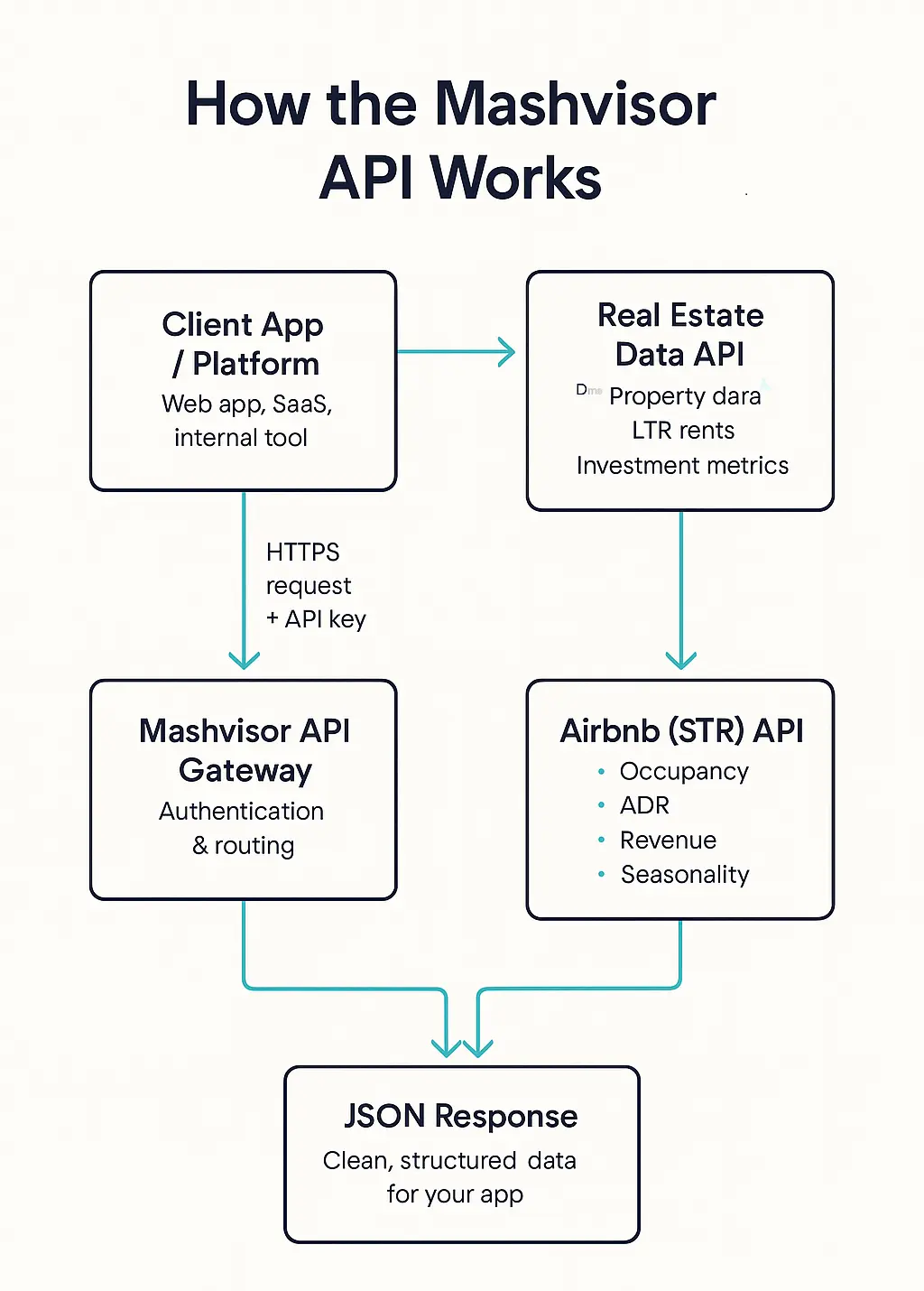
This architecture ensures that users can easily map data into:
- SQL and NoSQL databases
- Python dataframes
- Machine learning pipelines
- ETL workflows
- Investor dashboards
How Developers Interact with the API
Developers can access the Mashvisor API libraries by:
- Authenticating with an API key
- Calling specific endpoints, such as property, market, STR, LTR, historical data, comps, etc.
- Receiving JSON responses structured for analytical modeling
- Integrating the data into their applications or data pipelines
The API supports any language capable of making HTTP requests, including:
- Python (requests, aiohttp)
- JavaScript/Node.js (fetch, axios)
- Java
- C# / .NET
- R
- Go
- PHP
Because the API uses standard HTTPS and JSON formats, no proprietary libraries are required, and integration can be completed quickly by any experienced developer.
To help developers get started quickly, here is a simple example of how to fetch property data using Python:
import requests
API_KEY = “YOUR_API_KEY”
endpoint = “https://api.mashvisor.com/v1.1/client/properties/4589210”
headers = {
“x-api-key”: API_KEY
}
response = requests.get(endpoint, headers=headers)
data = response.json()
print(data)
And for users who prefer a quick cURL request:
curl -X GET “https://api.mashvisor.com/v1.1/client/properties/4589210” \
-H “x-api-key: YOUR_API_KEY”
Both examples illustrate the core workflow: Authenticate, send a GET request, and process the JSON response. This makes it easy to integrate Mashvisor’s real estate and Airbnb data into any tool, dashboard, or data pipeline.
How Analysts and Investors Use It Operationally
Beyond technical developers, real estate analysts and investment teams use the Real Estate API to automate:
- Market screening
- Rental rate summary
- Airbnb performance benchmarking
- Cash flow and ROI calculations
- Underwriting and deal analysis
- Competitor supply monitoring
- Scenario testing and forecast modeling
With these operational use cases in mind, it’s helpful to look at the exact endpoints the API exposes and the data each one returns.
What API Endpoints Does Mashvisor Provide?
With the core workflow in mind, the next step is understanding which specific endpoints are available and what each one returns. To help developers quickly understand the API’s structure provided by Mashvisor, here is a concise summary of the primary endpoints and what each one returns.
Mashvisor API Endpoint Summary
| Endpoint | Purpose | Use Case | Key Data Returned |
| /client/properties | Property-level attributes & metadata | Valuation
Deal analysis Property search tools |
Basic property attributes, structure, beds/baths, pricing, coordinates, status |
| /client/get-property | Full property profile with enhanced data | Deal analysis
Underwriting Valuation models Comps search |
Tax history, assessment history, transaction records, photos, Mashvisor AVM, Redfin-style valuations, nearby comps |
| /client/airbnb/listings | Airbnb performance metrics | STR revenue forecasting
Airbnb comps |
Occupancy, ADR, revenue, RevPAR, seasonality, active comps |
| /client/airbnb-property | Detailed Airbnb listing information | STR comps
Amenities parsing Arbitrage analysis Listing enrichment |
Amenities, images, host metadata, min-stay rules, calendar patterns, listing details |
| /client/rental-rates | LTR rate estimates | LTR analysis
Rental arbitrage |
Median rents (1-5 BR), rent distributions, local rental trends |
| /client/neighborhoods | Neighborhood-level analytics & investment indicators | Market evaluation
Neighborhood scoring |
Neighborhood ROI, STR/LTR benchmarks, demand indicators, comps |
| /client/historical_performance | Up to 36 months of monthly STR performance | Forecasting
Time-series modeling Underwriting |
Month-by-month occupancy, ADR, revenue, seasonality patterns |
| /client/search | Programmatic property search | Deal-finding engines
PropTech applications |
Paginated property search results with filters (price, beds, type, location, status) |
| /client/city/listings | Search Marketplace investment listings (active, inactive, distressed, off market) | Bulk ingestion
MLS-style search Deal screening Lead generation |
MLS-like listings, status, DOM, price/price history, ROI indicators, property attributes, distress flags, filters |
All endpoints follow a consistent structure detailedly documented in the Mashvisor API Documentation.
Behind these endpoints is a multi-source data engine that combines several categories of real estate, STR, and rental information.
What Data Sources Does the API Use?
The API provided by Mashvisor aggregates and harmonizes real estate and rental information from a range of proprietary, public, and third-party sources. This multi-source methodology is what allows the real estate data analytics company to offer a uniquely comprehensive and continuously updated dataset covering property intelligence, STR performance, neighborhood analytics, and long-term rental pricing.
Quick Summary: Mashvisor API Data Sources
- Airbnb Platform Signals: Calendar activity, pricing, occupancy, seasonality.
- MLS Listings and Real Estate Records: Property status, structure, pricing, transactions.
- Long-Term Rental Platforms: Rent distributions, bedroom-level rates, demand trends.
- Public Records and Government Data: Ownership, tax history, parcel boundaries, zoning.
- Internal Modeling and Predictive Analytics: Forecasting, smoothing, STR/LTR estimation.
Each of these sources plays a different role in shaping the accuracy and depth of Mashvisor’s platform, as outlined in the sections below.
Airbnb Platform Data
Mashvisor continuously monitors activity from the Airbnb website, capturing both real-time and historical signals. This data feeds directly into Mashvisor’s STR performance engine and includes:
- Occupancy indicators (observed and inferred)
- ADR trends, including high/low seasonal variability
- Nightly pricing fluctuations
- Minimum stay and availability patterns
- Calendar-level booking behavior
- Seasonal demand surges and compression events
- Listing-level amenities and property characteristics
- Host pricing strategies and competitor benchmarking
These platform-level inputs allow Mashvisor to generate accurate STR revenue estimates, RevPAR calculations, and seasonality models across every US market, no matter how big or small.
MLS and Real Estate Records
Mashvisor integrates residential real estate data from MLS feeds and partner listing providers. This ensures full property-level accuracy, including:
- Active for sale listings with real-time updates
- Recently sold comparables and transaction histories
- Price changes, days on market, and listing activity
- Structural property details, such as number of bedrooms and bathrooms, square footage, and year built
- Construction style, lot size, building type (studio, apartment, single-family home, townhouse, multi-family, etc.), and structure quality
- Renovation status and property condition (when available)
This dataset is essential for building valuation engines, property search tools, and underwriting models.
Public Records and Government Data
Mashvisor incorporates standardized public datasets comprising:
- Ownership and deed information
- Tax assessments and taxable value history
- Parcel boundaries and geospatial attributes
- Zoning classifications and permissible use rules
- Census and demographic indicators (by integration, not directly exposed)
These inputs help ensure accuracy in property identification, location intelligence, and compliance evaluation.
Rental Platforms and Public Rental Data (Long-Term Rentals)
To support both traditional buy-and-hold investors renting out on a long-term basis and rental arbitrage operators, Mashvisor aggregates LTR data from:
- Major rental listing platforms, such as Zillow, Hotpads, and RentJungle
- Property management listing services
- Public rental directories
- Localized rent distribution datasets
- Census and housing cost statistical sources
Combined, these sources allow Mashvisor to estimate:
- Median rent for 1-5 bedrooms
- Rent distributions by neighborhood or zipcode
- Expected long-term occupancy
- Seasonal variations in long-term rental demand
Predictive Modeling and Internal Analytics
Because many STR and LTR data points require interpolation or validation, Mashvisor applies proprietary advanced modeling techniques to refine accuracy. Internal analytics include:
- Machine-learning models for STR revenue forecasting
- Statistical smoothing for incomplete STR calendar signals
- Predictive long-term rent estimation using multi-factor models
- Time-series decomposition for seasonality measurement
- Neighborhood-level risk scoring
- Investment return modeling using standardized underwriting inputs
The analytics engine developed by the Mashvisor team ensures consistency within and across markets, even where raw data availability varies and data points might be limited.
Why the Multi-Source Approach Matters
By combining transactional data, MLS feeds, STR signals, rental listings, public records, and predictive modeling, Mashvisor delivers:
- Regular updates across all datasets
- Cross-validated accuracy from independent sources
- Nationwide coverage of both STR and LTR trends
- Reliable indicators suitable for underwriting and forecasting
- Consistent data structure across markets and property types
This blended data strategy is one of the reasons Mashvisor’s API is widely used by PropTech companies, institutional investors, portfolio managers, and data science teams.
Now that the underlying data ecosystem is clear, the next step is understanding the specific types of metrics and property insights the API makes available.
What Types of Real Estate and STR Data Does Mashvisor Provide?
Mashvisor API real estate data types cover a range of property, rental, STR, and investment analytics datasets.
Quick Summary: Available Data Categories Available
- Property Data: Physical attributes, price history, geolocation.
- Short-Term Rental (Airbnb) Data: Occupancy rate, ADR, revenue, comps, seasonality.
- Long-Term Rental Data: Median rents, distributions, historical trends.
- Investment Metrics: Cash flow, cap rate, cash-on-cash return, ROI comparisons.
- Market & Neighborhood Analytics: Demand indicators, comps, risk scoring.
- Historical STR Performance: Up to 3 years of monthly RE metrics delivered via historical performance API
Below is a deeper look at how these categories break down across short-term rentals, long-term rentals, property attributes, and investment performance.
What Airbnb Does the API Supply?
Mashvisor’s Airbnb API returns structured STR performance indicators for properties and markets, such as those provided by the Airbnb occupancy rate API, including:
- Airbnb occupancy rate: The percentage of nights booked out of the total available nights in a given month.
- Average daily rate (ADR): The average price guests pay per booked night.
- Monthly revenue: Total revenue generated in a month based on booked nights and ADR.
- Revenue per available rental (RevPAR): Revenue distributed across all available nights (booked and unbooked).
- Active listings: Number of competing STR listings in the local market.
- Seasonality index: A normalized measure of how demand and pricing fluctuate throughout the year.
- Property-level STR income: Mashvisor’s estimate of how much income a specific property can earn based on comps, performance patterns, and local market behavior.
- STR rental comps: Comparable STR listings used to benchmark performance, estimate revenue, and validate underwriting assumptions.
This dataset supports forecasting, revenue modeling, underwriting, STR pricing automation, and ROI analysis.
What Long-Term Rental Data Does the Mashvisor API Offer?
The Mashvisor rental data API covers long-term rental indicators such as:
- Median rental income (1-5 bedrooms): Typical monthly rent for different bedroom configurations, based on aggregated LTR listings.
- Rent distributions: Statistical spread of rental prices within an area.
- LTR occupancy patterns: Signals related to long-term rental demand, vacancy trends, and rental stability.
- Historical rental price trends: Multi-year rental price movements that reveal appreciation, demand shifts, and rent growth potential.
- Neighborhood-level rental comparables: Similar LTR units in the area used for benchmarking and validating rental rate estimates.
Investors use these metrics to assess traditional rental investment options, compare STR vs LTR performance, or evaluate arbitrage opportunities.
What Property Data Does Mashvisor Have?
The property data API includes detailed property attributes:
- Property address, coordinates, and smart location: Standardized geolocation and intelligent hierarchical location identifiers for accurate mapping and filtering.
- Property type (single-family, multi-family, condo, etc.): Determines STR suitability, occupancy limits, valuation models, and financing rules.
- Square footage and lot size: Key structural metrics tied to valuation, comparables, and renovation potential.
- Number of bedrooms and bathrooms: Major drivers of STR pricing, occupancy potential, and rental competitiveness.
- Year built: Used in assessing depreciation schedules, renovation needs, and long-term valuation.
- Property status (active, off-market, sold): Indicates current market availability and recent transaction behavior.
- Price and price history: Includes list price, prior sale prices, and historical price movement.
- Ownership attributes (when available): Ownership indicators or tax-related ownership information depending on county availability.
This enables developers to build robust real estate search, valuation, or portfolio management tools.
Those who need fast address-based or property-ID-based resolution can also use Mashvisor’s Lookup API, which streamlines property matching and validation.
What Investment Indicators Does the API Include?
Mashvisor includes built-in analytics:
- Estimated rental income (STR and LTR): Machine-learning-derived revenue projections using comps, market patterns, and property characteristics.
- Cap rate: Net operating income divided by property price – a standardized profitability metric used in underwriting.
- Cash on cash return: Annual cash flow relative to cash invested, reflecting investor’s actual return on capital.
- Operating expense ratios: Estimates of operational costs relative to revenue.
- Financing scenarios: Calculations incorporating loan terms, down payment, and interest rates to estimate leveraged returns.
- Rental strategy comparison (STR vs LTR): Side-by-side performance modeling for deciding the optimal rental strategy.
- ROI projections: Forward-looking return metrics using historical performance, comps, and market analytics.
This makes the API ideal for PropTech platforms building automated valuation or underwriting engines. Beyond traditional investment modeling, this dataset also unlocks more specialized use cases such as rental arbitrage analysis.
How Can Mashvisor’s API Be Used for Rental Arbitrage Analysis?
Mashvisor’s combination of STR data and LTR rental rate data makes it uniquely suited for arbitrage evaluation.
Users can analyze:
- Cost to rent long term vs short-term earnings: The core arbitrage profitability calculation.
- Arbitrage profitability by zip code: Identifying markets with favorable STR-LTR spreads.
- Market-level seasonality and demand cycles: Determining which months may affect cash flow reliability.
- Top locations for high-revenue spreads: Markets with strong STR income and moderate LTR costs.
- Risk factors such as STR supply fluctuations: Evaluating the sensitivity of revenue to market saturation.
This dual-data-layer advantage is a key differentiator vs STR-only APIs.
Since the API is used across such a wide range of markets and investment strategies, geographic coverage becomes an essential consideration.
How Much Market Coverage Does the Mashvisor API Offer?
Mashvisor offers nationwide US coverage, including:
- All 50 states
- Hundreds of thousands of cities, zip codes, and neighborhoods
- Millions of long-term rentals and property records
- 20+ million MLS listings
- 6+ million active LTR listings
- 11+ million active STR listings
- Historical data coverage spanning 3 years
This makes Mashvisor suitable for:
- Nationwide applications
- Multi-market comparative analysis
- Enterprise-scale STR modeling
- Institutional underwriting pipelines
To make this data more tangible, here are example JSON responses showing how it appears when retrieved through the API.
What Does an API Response from Mashvisor Look Like?
Before diving into the full sample JSON blocks below, here’s a quick look at how an actual STR response appears when retrieved through the API. This helps developers visualize the structure, nesting, and formatting they can expect when querying the Airbnb endpoints.
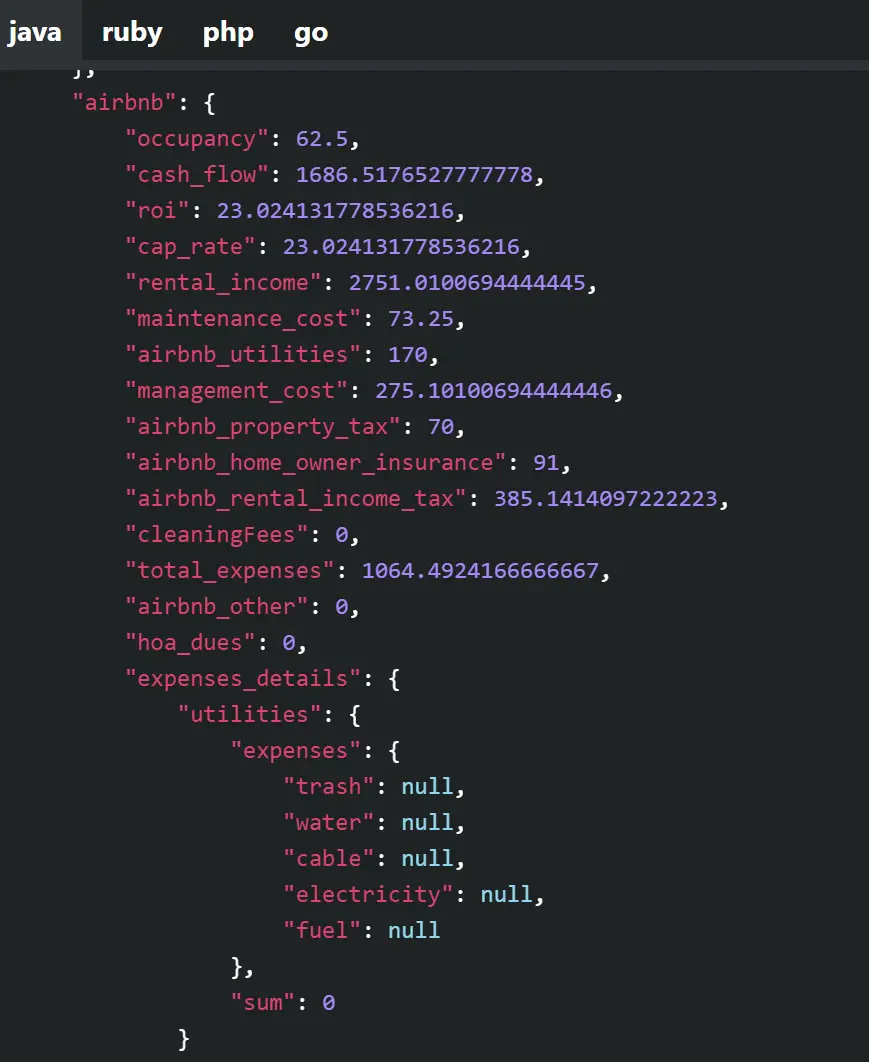
Example excerpt of a Mashvisor API STR response, including occupancy, rental income, expenses, and ROI fields.
Below are real-life examples of the Mashvisor API’s response:
Sample JSON #1: Combining Property Data and STR Metrics
Here is an API response bringing together property data and STR metrics:
{
“status”: “success”,
“content”: {
“property_id”: 4589210,
“smart_location”: “Las Vegas, NV, US”,
“property_type”: “Single Family Residential”,
“bedrooms”: 3,
“bathrooms”: 2,
“list_price”: 435000,
“airbnb_metrics”: {
“occupancy_rate”: 0.73,
“average_daily_rate”: 188.50,
“monthly_revenue”: 4123.75,
“revpar”: 137.61,
“active_listings”: 570
},
“long_term_rent”: {
“rent_1br”: 1400,
“rent_2br”: 1750,
“rent_3br”: 2100
},
“investment_metrics”: {
“cash_on_cash_return_str”: 0.112,
“cap_rate_str”: 0.087,
“cash_on_cash_return_ltr”: 0.053,
“cap_rate_ltr”: 0.041
}
}
}
Sample JSON #2: Airbnb Listing
Following is how an Airbnb listing response looks like:
{
“status”: “success”,
“content”: {
“listing_id”: 22991433,
“property_type”: “Apartment”,
“bedrooms”: 2,
“bathrooms”: 1,
“smart_location”: “Chicago, IL, US”,
“airbnb_stats”: {
“occupancy_rate”: 0.68,
“average_daily_rate”: 154.20,
“maximum_monthly_revenue”: 3560,
“minimum_monthly_revenue”: 1880,
“annual_revenue”: 39200,
“seasonality_index”: {
“january”: 0.72,
“june”: 0.95,
“august”: 0.98,
“november”: 0.65
}
},
“comparables”: [
{
“listing_id”: 22991210,
“occupancy_rate”: 0.70,
“adr”: 148.00,
“monthly_revenue”: 3200
}
]
}
}
How Can Investors Use the Mashvisor API?
The API enables investors to:
- Identify top-performing LTR and STR markets
- Compare STR vs LTR profitability
- Analyze arbitrage potential
- Estimate cash flow and ROI
- Access comps instantly across multiple markets
- Underwrite deals using objective data
- Build automated deal-finding tools
Investors using custom spreadsheets or internal tools can integrate the Mashvisor API to automate data intake and elevate analysis.
How Can Developers and PropTech Teams Use Mashvisor’s API?
On the development side, the Real Estate and Airbnb APIs are used to:
- Build investment dashboards
- Create STR forecasting engines
- Integrate property search and analytics
- Build comps-based valuation models
- Automate deal recommendations
- Feed machine learning systems
- Power mobile apps or SaaS tools
- Offer STR and LTR investment calculators
The API is developer-friendly and supports any JSON-capable language.
What Are the Key Benefits of Using the API of Mashvisor?
The main advantages of the API provided by Mashvisor include:
- Unified dataset: Airbnb data, long-term rental data, property data, and investment analytics all come in one interface.
- High Mashvisor API data reliability with frequent updates: Frequent updates, validation algorithms, and multi-source aggregation produce a highly accurate dataset. The platform updates STR data daily and MLS listing data multiple times per day.
- Detailed investment metrics: Built-in ROI indicators reduce the need for custom calculations.
- Ideal for arbitrage analysis: STR and LTR data synergy.
- Developer-friendly nature: REST structure, easy authentication, and consistent JSON responses.
- Scalability for enterprise use: The API supports large data volumes and high-frequency querying.
All in all, this technology allows professional and large-scale investors to perform market-level and property-level analysis faster and more accurately than even before. Meanwhile, developers are able to build custom platforms and apps based on a wide market range, trustworthy numbers, and in-depth analysis.
Are There Any Drawbacks to the Available API?
Mashvisor’s limitations are relatively minor and mostly technical:
- US-only data (no international coverage yet)
- Need for developer integration for automation
- Some variations in real estate attributes due to public data availability
However, these disadvantages are typical for high-volume real estate APIs, and Mashvisor compares favorably in coverage, cost, and ease of use with the best Airbnb data API providers.
How Do You Get Started With the Mashvisor API?
Getting started with the API offered by Mashvisor is easy and requires going through the following steps:
- Create a Mashvisor account.
- Book a free consultation with the Mashvisor data expert to learn in detail how the Mashvisor API works and how you can tailor it to your needs.
- Generate an API key from your user dashboard.
- Review the API documentation.
- Test endpoints using cURL, Postman, Python, or Node.js.
- Build your integration for property, Airbnb, or market data.
- Automate data retrieval for dashboards, underwriting models, or applications.
- Scale usage as your data needs grow.
Bottom Line
The Mashvisor API delivers one of the most complete and developer-ready real estate data solutions for anyone searching for the best real estate API on the market. With Airbnb, long-term rental metrics, property information, and investment analytics combined into a unified interface, it provides unparalleled support for investors and PropTech developers alike.
Whether you are building a large-scale real estate platform, developing an investment tool, or conducting detailed underwriting, the Mashvisor Real Estate and Airbnb APIs offer the accuracy, depth, and functionality required for high-level performance.
To get immediate access to the Mashvisor API, start your 1-week free trial including 30 credits.
FAQs
Does the Mashvisor API Include Historical Data?
Yes, it covers three years of real estate and rental data and analytics.
Can I Use the API for Rental Arbitrage Analysis?
Yes, absolutely. Mashvisor is one of the few APIs combining LTR and STR rates for arbitrage modeling.
Does the API Support Python?
Yes, any language that supports HTTP requests can use the API provided by Mashvisor.
What Markets Does It Cover?
The API covers the entire US market, including large cities as well as small towns and villages in all 50 states.
What Update Frequency Does the API Use?
Data is updated daily to ensure the most up-to-date information available on the market.
Can I Use the API for Underwriting?
Yes, Mashvisor provides metrics specifically designed for underwriting models including but not limited to cash flow, cap rate, cash on cash return, and more.
Does the API Support Bulk Data Retrieval or Batch Requests?
Yes, Mashvisor allows bulk retrieval through higher-volume plans and custom endpoints, depending on the user’s needs. For large datasets, enterprise users can request dedicated bulk access.
What Are the Rate Limits and Query Caps?
All packages include daily and monthly credit limits based on your subscription tier, with each endpoint consuming a set number of credits. Higher-tier plans offer significantly larger caps for high-volume integrations.
How Is the Mashvisor API Pricing Structured and What’s Included in Each Subscription Tier?
API pricing is credit-based, with each plan offering a different volume of monthly credits and access levels. Higher tiers unlock more endpoints, larger quotas, and optional enterprise features like bulk data access. With each plan, you get a 7-day free trial covering 30 credits.
Does Mashvisor Offer Enterprise-Level Plans?
The API can be used equally efficiently by smaller- and larger-scale professional investors and PropTech development companies. Mashvisor offers flexible pricing to suit different needs and budgets.







 English (US) ·