
Selling a house can feel a little overwhelming, especially when your to-do list is packed with home upgrades and repairs you’re not excited to tackle. Maybe the roof’s seen better days, the kitchen never got that remodeling glow-up, or the place simply falls into the “homes in poor condition” category. You might be wondering if buyers will run the other way or if you’ll get buried in endless negotiations over every squeaky hinge and cracked tile. So you’re naturally curious about how to sell a house as is.
When you sell a house without repairs, it often means pricing your home lower, but it’s a reasonable tradeoff. After all, buyers shopping for homes in as-is condition aren’t looking for perfection. Outdated features, like an old electrical panel, worn carpets, or a retro kitchen, won’t put them off. And if you’re short on time or not interested in back-and-forth negotiations, it might make more sense to take a fair offer and move forward quickly.
Sell Your House As-Is and Compare Options
House needs work? No problem. Skip repairs, staging, and showings. Get an all-cash offer in 24 hours with HomeLight’s Simple Sale platform and close in as little as 7 days. You can also request an expert estimate of what your home might sell for using a top-rated agent.
To sell without doing repairs, you’ll need to find buyers willing to take on homes that might need a little TLC. But you certainly don’t want to leave any money on the table. So, how do you pull off a profitable, quick as-is sale?
To get answers, we called on a highly experienced group of as-is home sale experts for the scoop on how to nail an as-is sale.
Without further ado, here’s what the experts have to say about selling a house as-is. In the end, hopefully, you’ll be able to answer the question, “Should I sell my house as-is?” with confidence.
What does it mean to sell a house as-is?
Selling a house as-is means a buyer will purchase your home without you making any repairs. The term can be used broadly to simply refer to a home sale for a house that hasn’t been recently updated or needs repair.
According to Mandy Williams, a top-performing agent in Birmingham, Alabama who gets 98% of her listings sold, an as-is sale can look a lot different than a turnkey transaction. “A lot of buyers expect to walk into a house that’s listed on the traditional market and see a home that’s been completely updated to today’s trends and standards,” she explains.
But marketing your home as-is conveys to buyers that your home may be in imperfect condition, notes Jena Bebleh, a top agent in San Jose, California, with over 20 years of experience.
“In an as-is sale, a buyer is purchasing a home in its current condition,” she says. “That may mean the seller won’t do any repairs, even if they come up on an inspection report. The buyer is willingly purchasing the home in its current state with full knowledge of its condition.”
That last bit of her comment is critical to grasp. By selling as-is, you aren’t absolved of the duty to share what you know about the home with buyers. An as-is label, particularly on an open market sale, is not a fail-safe to avoid all negotiations.
That said, selling as-is can still be a viable strategy if you go about it the right way.
Jeff Shipwash of Shipwash Properties in Knoxville, Tennessee, flips multiple houses each year and routinely buys as-is properties. As an experienced investor, he explains, “If you own a home that needs several repairs and don’t have the finances, or simply don’t have the time or desire to undergo the stress of home remodeling, selling as-is could be for you.”
Why you might consider selling your house as-is
Rather than throwing lots of time and money at your home, you may choose to sell it as-is and get on with your life. Here are the main reasons to sell your house as-is:
- No time for remodeling: An as-is home sale is one of the best moves when you need to sell fast, and you can’t make time for renovations and long back-and-forth negotiations.
- No cash for renovations: Sometimes, pouring money into remodeling is out of the question. According to Williams, this is the most common reason to sell as-is. If you lack the cash to revamp the kitchen or redo the flooring, you can sell to a buyer who’s prepared to invest.
- Lack of desire: You may simply not want to take on a big fixer-upper project. “I see a lot of sellers who’ve inherited a home from a family member, but they’re in their forties, in the prime time of their careers,” Williams says. “They just don’t have time to take on a project like that. Or, they may just not want the hassle.”
- Ready buyer: If you have a buyer on standby who’s willing to purchase your home as-is, you can skip listing with an agent and move straight into the sale.
- Unlivable home: When safety hazards abound, selling as-is to a real estate investor may be your best bet. Otherwise, you’re stuck paying a lofty sum to fix huge problems like a broken furnace or leaking roof.
What buyers expect from an as-is home sale
Selling your home as is doesn’t mean buyers will come without expectations. Most buyers understand that an as-is sale means the seller won’t be making repairs, but they still want to know what they’re walking into. Transparency is key to building trust and keeping your deal on track.
Here’s what buyers typically expect in an as-is sale:
- Opportunity to inspect the property: Most buyers will still hire a home inspector, even if they can’t request repairs. They want to understand the home’s condition and whether the price reflects any necessary work.
- Honest disclosures: Even in an as-is sale, you’re usually legally required to disclose known material defects. Hiding issues can lead to legal trouble down the road or scare off serious buyers once problems come to light.
- Fair price: Buyers expect a discount if they’re taking on repairs themselves. Pricing your home realistically helps attract offers and shows buyers you’re serious about selling.
- No surprises: Buyers aren’t looking for perfection, but they don’t want to be blindsided by major issues. The more upfront you are, the smoother the sale will go.
When you meet buyers with honesty and realistic pricing, you increase the chances of closing without unnecessary delays, even without making a single repair.
How to sell a house as-is
Here’s what you need to know to nail an as-is home sale, plus major pitfalls to avoid, according to top agents.
Factor as-is into your pricing, but don’t get lowballed
Consider high-return projects that aren’t much work
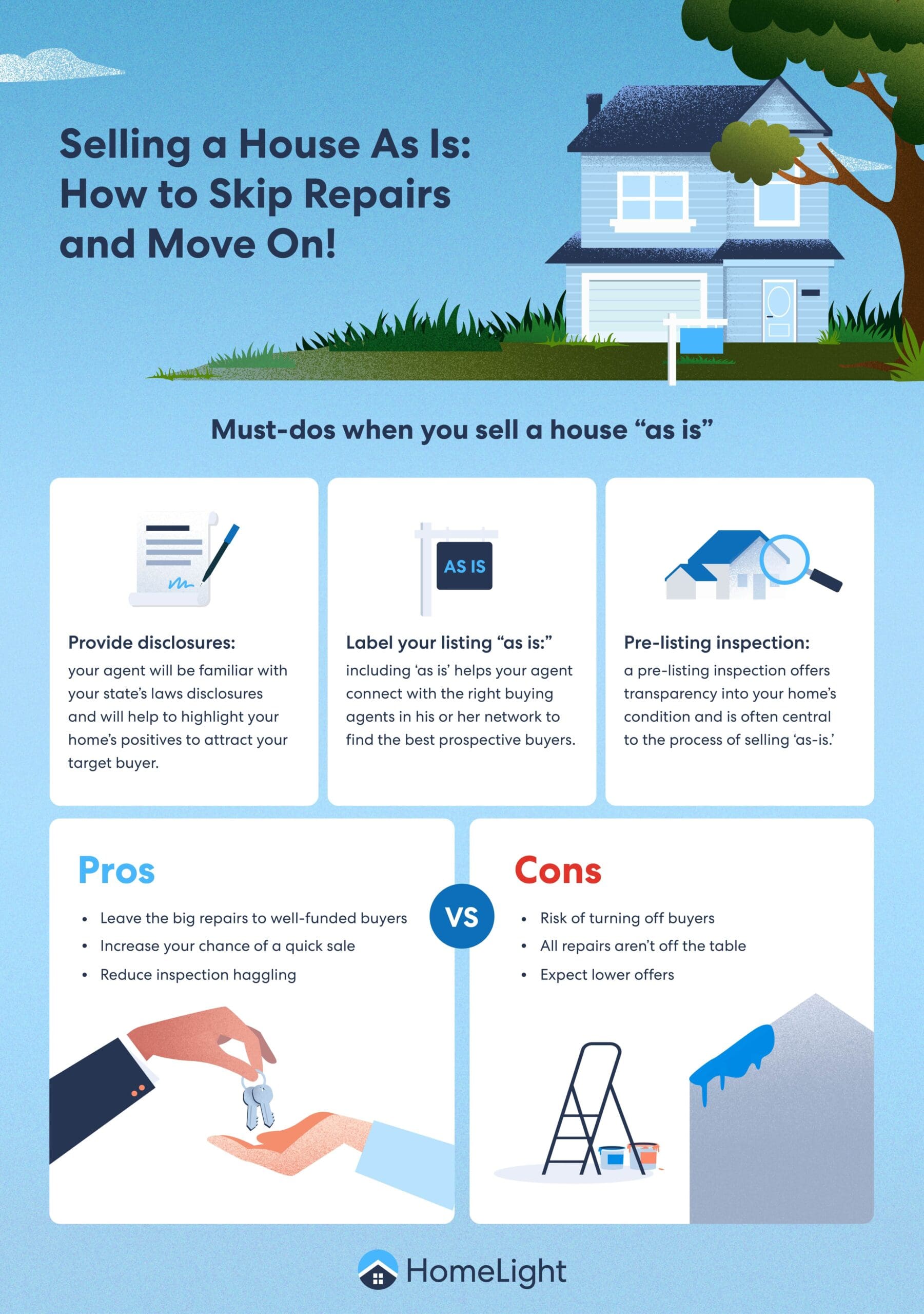
Provide disclosures
Label your listing ‘as is’
Consider a pre-listing inspection
Address ‘deal killers’ if possible
Skip pricey cosmetic upgrades
1. Factor as-is into your pricing, but don’t get lowballed
To successfully and quickly sell your home on the market as-is, you can’t expect to price it the same way you would if you’d planned to make targeted upgrades and repairs.
“It’s all about pricing,” Williams states. She says that she sees sellers fall into the trap of setting their prices based on idealized numbers they find on the web. “When it comes to selling as-is, the number you see online may not be the right price.”
According to HomeLight’s Top Agent Insights for Q3 2025, 77% of agents said that setting the price too high is the top mistake sellers tend to make.
“I truly believe there’s a buyer out there for every home,” Williams explains. “But you have to figure the cost of repairs into where you price the house.”
Elizabeth Weintraub, a top agent in Sacramento, California, agrees. She says that sellers should work with an agent who can provide a voice of reason amidst conflicting information on the internet, and even against predatory fixer buyers who try to take advantage of as-is sellers.
“The problem is pricing it correctly to reflect the repairs required without leaving any money on the table to maximize seller profit,” explains Weintraub, who has been handling real estate transactions for 47 years.
She says that these lowballers may use scare tactics like, “Nobody will buy your house in this condition, but me,” or pressure along the lines of, “This is the best offer and only offer you will get, and it expires in six hours.” An agent can help you see those tactics for what they are and sell your home for its market value.
2. Consider high-return projects that aren’t much work
While selling as-is can mean skipping projects entirely, focusing on easy, high-return fixes can help you boost your home’s price with minimal cash and effort.
Robert Taylor, a real estate investor and rehabber in Sacramento, California, with decades of experience, advises avoiding repairs that will only marginally increase your home’s value. He shares the formula that’s helped him keep his real estate transactions profitable.
“I look at repair costs and the home’s future value as a one-to-one relationship,” Taylor explains. “If I spend ten dollars on repairs, I want to see the home’s value increase by the cost of repairs, plus ten dollars. If I spend $20,000 on repairs, I expect to be able to increase my home’s value by $40,000.”
Here are a few smaller projects that would meet Taylor’s benchmark as being worth the investment, even if you’re selling a house as-is:
- Spruce up your curb appeal: Amplifying your home’s curb appeal helps boost its marketability. A beautifully manicured lawn offers an impressive return on investment (ROI) of 217%, and a new garage door can recoup about 268% of its cost.
- Deep clean and declutter: According to HomeLight’s Top Agent Insights for Q3 2025, not decluttering and depersonalizing is the biggest home prep mistake sellers make, and it can seriously hurt their chances of a smooth, successful sale. Be diligent about deep cleaning, hauling out old junk and furniture, and removing clutter. “Every seller should clean and declutter when they sell as-is,” Williams urges. “Get rid of all that old stuff on the front end. It looks terrible in photos.”
- Add a fresh coat of neutral paint: Painting your walls a crisp white or warm gray depersonalizes the space to attract more offers, and the effort also adds an average of $12,130 to the median-priced home’s value.
3. Provide disclosures
Selling as-is isn’t a loophole to avoid telling buyers your roof is leaking or the home needs all new plumbing. Most states have mandatory disclosures, and failing to disclose information potentially opens you up to legal liability.
“A lot of sellers say, ‘I’m selling it as-is — I don’t even want to talk about what I got going on here,’” says Edward Kaminsky, a real estate agent in Los Angeles with almost four decades of experience. “That can come back to bite the seller because if it’s proven that they did not disclose something they were fully aware of, they can be held liable after the close of escrow.”
Williams notes that her state, Alabama, is a “caveat emptor” state or, in layman’s terms, a buyer-beware state. That means it’s the buyer’s duty to inspect the home. But it doesn’t relieve sellers of all responsibility.
“We’re still required to disclose all health and safety issues, like black mold or lead-based paint,” Williams says. But she adds reassurance that even with health and safety hazards, many investors will still buy the home: “Just make sure you have that in writing.”
Every state has its own legal requirements for disclosures, so check with your agent. They’ll be familiar with your state’s disclosure laws and can help to highlight your home’s positives, such as a large yard or great location, to attract your target buyer. Work with a top agent in your market state to ensure you’re aware of the local laws.
4. Label your listing ‘as-is’
Unless a listing specifically has the language of being sold as-is, buyers are going to assume it’s a regular sale.
“Including ‘as-is’ helps your agent connect with the right buying agents in our networks to find the best prospective buyers,” Bebleh says. “The client knows right away the seller won’t be doing any repairs.”
When writing your listing description, strive for transparency by clearly describing the property’s current condition. Remember, some as-is buyers, especially those seeking a residence, are often concerned about hidden repair costs, financing hurdles, safety hazards, and the time and effort required for renovations.
That said, your listing should be upfront about the home’s needs and any potential challenges. Honesty is key to building trust with buyers, allowing them to make informed decisions and feel confident about what they’re committing to. By setting realistic expectations, you can attract serious buyers who are prepared to take on the work that needs to be done after the sale.
On the flip side, be sure to highlight your home’s best features in the listing. Maybe it’s in a great neighborhood with easy access to top schools, or it’s just a short walk to parks and public transportation. If the house has a big backyard, that’s a huge draw for families who are fond of hosting parties or spending time outdoors.
Whatever makes your home special, make sure to emphasize those positives. By focusing on the property’s strengths, you’ll catch the attention of buyers who can see the potential, even if the home needs a little work.
5. Consider a pre-listing inspection
There are a couple of key reasons you might opt for a pre-listing inspection. First, it can be beneficial to have a third party come in for an unbiased opinion. “You don’t want to get to closing and be hit with an inspection report that shocks you,” Williams says.
It’s especially disconcerting when you’ve lived in your home for decades, and the buyer’s inspection unearths details about your home that you didn’t expect. “You feel like they don’t know the home like you do because they’ve never lived there,” Williams continues. “And you’ll say, ‘What? There’s not a leak here!’” Getting transparency upfront saves you from any surprises.
Secondly, you’ll receive more non-contingent offers if you disclose everything you know about the home from the start, according to Bebleh: “Buyers will know exactly what’s wrong with the house and submit an offer based on that.”
6. Address ‘deal killers’ if possible
While a buyer may be willing to overlook some cosmetic issues, many won’t be able to look past these big-ticket repairs. If you have the funds, you may want to prioritize these items to avoid attracting bad deals from buyers who capitalize on lowballing unappealing homes:
- Structural issues: According to Angi, foundation repairs can cost anywhere from $2,224 and $8,134. “It’s a huge can of worms,” Bebleh says. “It’ll really scare off some buyers.”
- Pest infestation: The damaging effects of termite infestations cost an average of $3,000 to resolve. Because the extent of the destruction can be hard to see, and treating the infestation early is key to mitigating the problem, buyers tend to be wary of pest-infested homes.
- Black mold: “People are terrified of mold and mildew,” Williams stresses. “If you’ve got anything black growing, you definitely need to have a professional come check that out.” Mold remediation costs between $1,223 to $3,753 on average.
- Old, worn roof: Replacing a roof will cost $5,870 to $46,000. While not every buyer will walk away, a worn or aging roof can raise concerns and may lead to tougher negotiations or lower offers.
7. Skip pricey cosmetic updates
Before you consider making repairs to your home, balance their cost and time requirements against their ROI. Taylor points out that time is an often underappreciated factor here.
“If a homeowner is already living in a different home, they need to consider the extra cost of insurance, possibly two mortgages, plus utilities,” Taylor says. “Sellers often forget that these carrying costs reduce the return they’ll get on their home.”
Avoid these two notoriously poor ROI projects:
- A mid-range major kitchen remodel costs about $82,793 and adds roughly $42,130 in resale value, so you’re only getting back around 51% of what you put into it.
- An upscale bathroom addition will cost around $111,255 and return about $40,256 when you sell, with an ROI of 36% only.
What are your options to sell a home as-is?
You may assume that selling as-is always works the same way. But you actually have two main avenues to explore: requesting a cash offer or selling as-is with an agent. Let’s review both options.
Request a cash offer
One option to consider is going immediately to a pool of cash buyers who aren’t as worried about your home’s condition and asking them: Would you buy my house? Seriously, that is a possibility. Here’s how it works.
- Contact a cash buyer: Most cash buyers prefer to purchase homes off-market, so you’ll need to reach out to them. We recommend our Simple Sale platform as a good starting point. Get started by telling us a bit about your home and how much work it needs, and we’ll connect you to one of the largest networks of cash buyers in the U.S. You will receive a no-obligation cash offer in just 24 hours.
- Let the buyer assess your home and situation: The house-buying company will schedule a visit to evaluate the property’s condition and learn more about your circumstances. After the walkthrough, they’ll typically present a cash offer either on the spot or within a few hours or days.
- Skip repairs: There’s no need to call the roof inspector or drain your savings to replace the HVAC system. You don’t have to worry about major flaws in your home because a house-buying investor will have the capital to make repairs, and you’ll be able to sell a house as is for cash. Simple Sale provides cash offers for homes in almost any condition.
- Sell when it’s convenient: Do you want to get out right away? Or do you need a little more time to pack? Either way, your Simple Sale offer timeline can be flexible. Within 30 days of closing, pick a move date that works for your schedule.
- Close with certainty: Cash buyers don’t need a lender’s involvement to purchase a home, meaning they can move nimbly and quickly compared to someone who needs financing. That can make for serious time savings. With a cash offer, you can skip over the red tape and avoid a collapsing home sale.
Curious to know more about the Simple Sale experience? Hear it firsthand from one of our valued clients in the video below.
Sell as-is on the open market
Perhaps your home isn’t a total teardown, and you’re willing to see what kind of deal you could strike on the open market. In that event, you can list your home for sale, ideally with a pre-listing inspection and prepared disclosures, at a fair price and try to keep your work on the home to a minimum.
In some cases, you may want to determine if there are any projects worth tackling, even if it’s a pared-down version of what might be typical for a regular sale. You can go about this in two ways:
Hire an agent with as-is experience: To avoid a bad experience selling a house in poor condition and requiring extensive repairs, Williams advises: “Work with an agent who’s familiar with closing traditional sales and those geared toward the investor market, one who knows the best of both worlds.”
Weintraub agrees: “In these situations, agents need to do a lot of homework, checking out the buyers’ reputations, looking for ways buyers might try to renegotiate and squashing those efforts, [helping] their sellers make the right decision.”
Sell your home as-is by owner: For-sale-by-owner (FSBO) is a method of selling your home without the involvement of a listing agent. In a FSBO scenario, the seller assumes all the responsibilities, such as pricing the home, arranging showings, and negotiating.
However, this could mean leaving money on the table, especially with an as-is sale. According to a National Association of Realtors (NAR) report, FSBO homes sold at a median of $360,000, significantly lower than the median of agent-assisted homes at $425,000.
What as-is buyers will pay
When you sell a home as is, expect to net less, usually around 75 % to 95 % of its after-repair value (ARV), depending on the buyer type and property condition.
- Cash buyers and investors typically offer around 70% of the after-repair value (ARV) minus estimated repair costs. For example, a home with an ARV of $440,000 and $30,000 in needed repairs might sell to an investor for about $278,000, calculated as 70% of $440,000 ($308,000) minus the $30,000 repair estimate.
- Owner-occupant buyers usually negotiate a smaller discount, as they purchase for personal use rather than profit. Since they plan to live in the home, they’re often more focused on location and long-term value than squeezing every dollar out of the deal, so they may be willing to pay closer to market price, even if the home needs some work.
Homes in better condition tend to land at the higher end of the 75 to 95 % ARV range.
Factors that impact pricing
- Home condition: Homes needing only minor updates often fetch closer to 95 % of ARV, while properties with serious issues might only achieve 75 % or less.
- Location and market trends: Homes in desirable neighborhoods tend to hold their value better, even when sold as is. Strong demand in the area can reduce the need for deep pricing discounts.
- Financing terms: Buyers using traditional financing may offer more, but they often require the home to meet certain lender standards. Homes in poor condition may attract more cash buyers, who typically offer less but can close faster.
Which is more profitable: selling a home as-is or after making repairs?
Suppose you’re selling a home worth about $410,000. The estimated repair cost is $30,000 and the after-repair value is $440,000. You’re deciding between selling it as is for around $278,000 or making the repairs and aiming for a full-price sale.
Here’s a side-by-side comparison to show how each option could affect your bottom line:
| Sell as is to a house-buying company | Repair first and sell with a Realtor | |
| Estimated sale price | ($440,000 × 70%) − $30,000 = $278,000 | $410,000 |
| Market preparations | $0 | $4,100 (1% of sale price) |
| Agent commissions | $0 | $12,300 (3% of sale price) |
| Closing costs | $0 | $6,150 (1.5% of sale price) |
| Estimated net profits | $278,000 | $387,450 |
In this example, selling as is brings in $109,450 less than repairing and selling at full market value. However, the as-is route offers speed, fewer out-of-pocket expenses, and no renovation headaches. It may be a better option if you’re in a hurry or don’t want to take on the risk and stress of repairs.
What are the pros and cons of selling a house as-is?
Selling as-is can be a solid choice if you’re in the midst of a shifting real estate market or you’re simply planning to move fast and want to skip the stress and hassle of negotiating with picky buyers.
Pros to selling your home as-is
- Leave the big repairs to well-funded buyers: Sell your home to a real estate investor who has the knowledge and funds to knock down a kitchen wall and install marble counters in an attempt to resell your home for more. That way, you won’t have to spend the time or foot the bill.
- Increase your chance of a quick sale: As-is buyers are often cash investors. Without the financing requirements of lenders or the hassle of last-minute repairs before closing, you can shorten your closing timeline to as few as 10 days.
- Reduce inspection haggling: On average, buyers negotiate $14,000 in savings based on inspection findings. With an as-is sale, you can try to set an appropriate price discount and communicate to the buyer that you’re not planning to offer further credits or repairs on the home, saving stress during closing.
But while there are plenty of good reasons to sell as-is, you’ll need to weigh the positives against the negatives to make the best choice for your home sale. Here’s what to consider.
Cons to selling your home as-is
- Risk turning off buyers: Some buyers see as-is and read “red flag.” According to Kaminsky, buyers tend to feel more comfortable offering a higher price knowing they can ask for necessary repairs during the inspection phase (and you’re not saying upfront that you’re unwilling to work with them).
- Make repairs still, since they aren’t totally off the table: Just because you list as-is doesn’t necessarily mean a buyer won’t attempt to negotiate the costs of repairs. Of course, it’s at your discretion to determine whether accepting an offer with a request for repairs is advantageous to your bottom line. If a buyer makes a good offer and asks you to cover the cost of repairing a damaged window, for example, you might do the math and decide it’s a good deal.
- Expect lower offers: When you sell as-is, you’re more likely to lose money with price concessions. As Williams puts it, “If you aren’t willing to put some money in, you may be leaving some money on the table.”
What are the ‘Minimum Property Requirements’ when selling an as-is home?
Minimum property requirements (MPRs) are safety, security, and health standards a home has to satisfy to be considered inhabitable. Each lender has its own standards for what meets MPRs, but common baselines include functional heat, a working roof, and a structure free from decay.
If a buyer is working with certain homebuyer programs, such as a Federal Housing Authority (FHA) loan, falling below MPR standards could be a deal killer. As an as-is seller, you can work with an expert real estate agent and consider a pre-listing inspection to determine whether your home is likely to meet financing requirements. If not, tailor your listing to real estate investors with the capital needed to buy your home in cash and rehab it.
FAQs on selling a house as-is
Selling a house as-is means offering the property in its current condition without making any repairs or improvements. Buyers accept the property with all its known or unknown issues, relieving the seller of any responsibility for fixing or disclosing those issues.
Selling a house as-is can be a viable option depending on your circumstances. It’s advantageous if you don’t want to invest time or money into repairs or renovations, as it attracts homebuyers and investors seeking fixer-upper properties.
However, selling as-is may result in a lower sale price. Consider the property’s condition, market demand, and your financial goals to determine if selling as-is aligns with your specific situation. Consulting with a real estate professional can provide valuable guidance.
Yes, many homeowners sell their houses as is, especially if they want to avoid costly repairs. It’s common in hot markets where buyers are willing to take on fixer-uppers or when sellers need to move quickly. However, pricing it correctly is key to attracting serious buyers.
It depends on your budget, timeline, and market conditions. Making strategic repairs can increase your home’s value, but selling as is saves time and upfront costs. If repairs are too expensive or time-consuming, selling as is may be the best option.
Not necessarily, but it can make buyers more cautious. Some assume major issues exist, so full disclosure and a fair price help ease concerns. Highlighting the home’s strengths can attract buyers willing to take on minor repairs.
Yes, you can sell a house as-is, even if it needs repairs. Selling as-is can be an attractive option for sellers who don’t have the time, funds, or desire to make repairs. However, it’s important to disclose known issues honestly to potential buyers to maintain transparency and avoid legal complications.
Selling a house as-is may impact its price since buyers typically expect a lower price for properties that require repairs or renovations. To determine how much you should sell your house for, consider obtaining a professional inspection and assessing the cost of needed repairs, adjusting the price accordingly to attract potential buyers.
Yes, there are legal considerations when selling a house as-is. Ensure you comply with local laws regarding property disclosures. Some jurisdictions require sellers to disclose known defects or issues, even when selling as-is. Consult with a real estate attorney or local real estate agent to understand and fulfill your legal obligations.
When marketing a house being sold as-is, be transparent about its condition in your listings and promotional materials. Highlight any unique features or potential opportunities the property offers.
Keep in mind your target market: investors or homebuyers looking for renovation projects. Invest in professional photography to present the property in the best possible light, even if it requires repairs.
Start by setting a competitive price based on market research and comparable sales. Market your home online, disclose its condition honestly, and prepare for negotiations. Using a real estate attorney can help with paperwork and legal requirements.
Avoid over-improving areas that won’t bring a high return, like luxury upgrades or full-scale renovations. Cosmetic issues like minor wall scuffs or outdated fixtures are often better left as is. Focus on essential fixes that impact safety or functionality, like plumbing or roofing problems.
Skip Repairs With a Cash Offer or an Expert Agent
Use HomeLight’s Simple Sale platform to request a no-obligation, all-cash offer and close in as few as 7 days. You can also request a top agent’s sale price estimate so you can compare your options.
A final word on selling a home as-is
If you don’t have a stash of cash or spare time to dedicate to renovations, or if you simply don’t want the hassle of drawn-out negotiations, you might decide to sell your home as-is. Just remember these key takeaways:
- Selling as-is can help you close on a sale much sooner, but you’ll likely receive a discounted price. To avoid getting taken to the cleaners, work with an experienced agent who can help you reject lowball offers and maximize value.
- Explicitly include as-is in the listing. Otherwise, buyers won’t get the memo.
- Consider ordering a pre-listing inspection to avoid surprises and set the home’s price accurately.
- Understand that even if you list as-is, some buyers will try to negotiate on the inspection. Again, a great agent can help you navigate through it.
- Avoid pricey upgrades, but know that tidying up, making small cosmetic repairs, and investing in curb appeal can go a long way.
When your house needs a lot of work, most regular buyers won’t be interested. Consider connecting with a house-buying company through a platform like Simple Sale if you want your house sold as-is. You can receive a no-obligation, all-cash offer in just 24 hours, and close in as few as 7 days.
Alternatively, you can partner with a reliable real estate agent who specializes in selling homes that need repairs. The right agent can connect you with traditional buyers who are open to renovation projects and may be willing to pay more. Use HomeLight’s free Agent Match tool to find a top-performing agent in your area who understands your goals.
Header Image Source: (Roger Starnes Sr / Unsplash)










 English (US) ·