
Having real conversations and really listening is your best shot at being there when life changes force a sale and relocation, Chris Drayer writes.
I’m a bit of a data nerd. Maps, charts, anything that helps make sense of what’s happening in the market (and maybe even predict where it’s going). So, like a lot of you, I spent time digging into this recent Inman Market View piece on where sellers listed despite higher rates.
My takeaway is clear: The market feels unpredictable. Listings are still below pre-pandemic levels nationally, but improving in many places. Some markets are gaining momentum, others remain constrained. Days on market is still low in pockets, even as we’re dealing with higher rates and worse affordability.
It’s uneven, it’s fragmented, and the future is harder than ever to understand.
So the question becomes: How do you actually stockpile pre-listings in a market like this?
Start by thinking about your last three or four listings. Why did those homeowners actually move? The real reason.
For most agents, the answer is consistent: A job change. A relocation. A divorce. A growing family. A windfall.
Not mortgage rates. Not gas prices. Not global conflict.
Life.
That’s always been true. Even in the early 1980s, when mortgage rates exceeded 18 percent, people still bought and sold homes. Transaction volume dropped, but still averaged roughly 2.5 million homes sold per year, and that was with a U.S. population of about 230 million — roughly one-third smaller than it is today.
The market slowed. But it didn’t stop. Life didn’t stop.
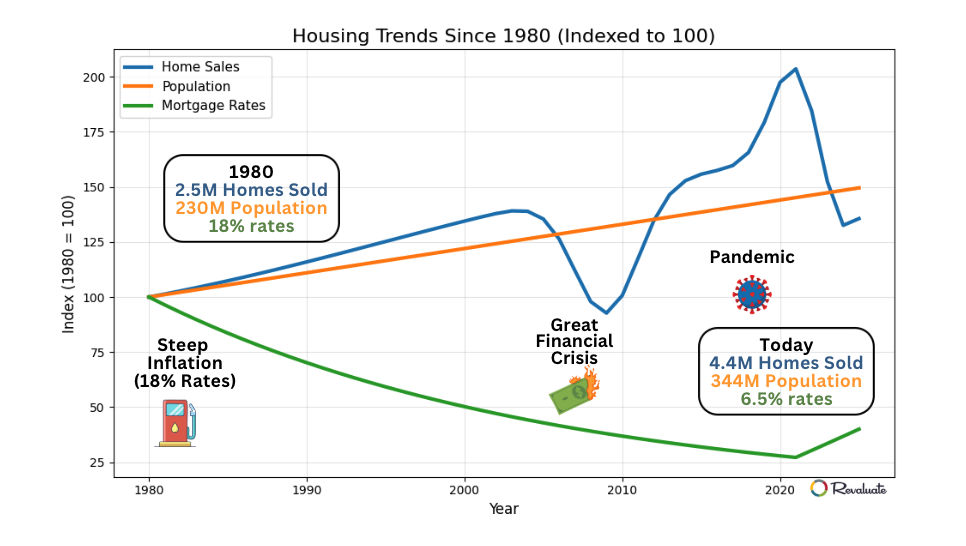
What changes with rates isn’t why people move. It’s when they act.
Lower rates increase the number of people willing to move. Higher rates cause some to wait. But underneath that timing decision is still the same driver: Something in their life has already changed. And that’s where the opportunity is.
If you want to stockpile pre-listings, you have to get closer to that moment, before it becomes obvious.
Lean into relationships
That starts with something simple: talk to your people.
Not surface-level check-ins, but real conversations. Listening for what’s changing in someone’s life. What’s working. What’s not. What they’re starting to think about, even if they’re not planning to move right now.
A version of this question was shared with me by Barry Jenkins of Better Homes and Gardens Real Estate in Virginia Beach: “If you were going to stay in this home for many more years, what’s the one thing you would change?”
On the surface, it feels casual. But if you listen closely, it often reveals much more.
- “We’d probably need another bedroom … the kids are still sharing.”
- “I’d love a bigger kitchen … we’ve outgrown this one.”
- “I wish we had a home office … I’m working from home more now.”
That sounds like small talk, but that’s intent.
Agents who read between the lines will hear what’s really being said:
- A growing family that needs more space
- A shift in how the home is being used
- A gap between where they are and where they’re headed
Those are the early signals of a move, long before it shows up as a listing. And this is where agents can create real value, with or without any technology.
Remember those conversations by writing them down and following up when timing starts to align with reality. That’s how pre-listing inventory is built.
Not by chasing expensive hot leads, but by staying close to the people who are going to move anyway.
Focus on what matters most
In a fragmented market, that edge matters more than ever. Some homes are still selling quickly. Some markets are improving. Others are stuck.
But the underlying truth hasn’t changed: The market doesn’t create moves. Life does.
Agents who focus on that — who stay close to their people, listen carefully and track what’s changing — don’t have to guess where the market is going. They already know where their next listings are coming from.
That’s how pre-listings are built, even in a market that feels unpredictable.
Chris Drayer is co-founder of Revaluate, which segments consumers for marketers by propensity to move.




 English (US) ·