
When you buy a house with other people, you gain the luxury of sharing the load. Surprise repairs, bills, yard care, and maintenance become a group effort.
Sometimes, it’s a chance to go in on a rental property when you can’t afford to do so alone, or maybe you’re buying that vacation house you’ve always dreamed about with friends.
But selling a house with multiple owners can be a nightmare scenario if it isn’t planned out. And if everyone involved isn’t aligned from the start, you can end up disagreeing on important details when it comes time to sell — potentially wrecking the sale and wasting everyone’s valuable time.
Fortunately, there are ways to set up a smooth sale on a co-owned property. In this guide, we dive into some of the types of co-ownership scenarios you should know about, look at the advantages and disadvantages of each, and lay out tips from professionals on selling a house with multiple owners.
Find a Top Agent to Help Navigate Your Sale
Selling a house is always complicated, especially when you have multiple owners. We analyze over 27 million transactions and thousands of reviews to determine which agent is best for you. Our service is 100% free, with no catch. Agents don’t pay us to be listed, so you get the best match.
Who may be selling a house with multiple owners?
Before you decide to move forward with selling a house with multiple owners, it’s important to understand what type of ownership category your home falls into. Each type of ownership carries unique advantages, disadvantages, and considerations. Here are a few of the most common types of home co-ownership scenarios, along with how each situation could affect your sale:
Tenancy in common
A tenancy in common (TIC) is a situation where multiple people can own the same home. With TIC agreements, you typically can establish as many owners as you want, and they don’t need to split the investment equally. You also don’t have to be married to enter into TIC.
One important thing to think about if you’re considering a TIC is that most of the time, you won’t have rights of survivorship, which means that if one of your co-owners dies, their share of the property is passed on to their heirs. This can quickly turn into a tricky situation, as you may end up sharing a property with a person or people you don’t know all that well.
TIC can be a good option for multiple owners who want to split responsibilities or divide ownership. It’s also a solid way to set up fair ownership expectations for people who plan to contribute unequal amounts of money into the property.
You typically can also buy out a share of property under a TIC agreement fairly easily. “If you have two people on the deed and they come to an agreement and say, ‘Hey, I want to buy you out,’ that’s very simple,” says Steven B. Herzberg, a real estate attorney at VHL Law in Miami, Florida. “All you do is come to your terms, transfer funds, and that person signs a deed of their interest to the other person.”
However, if you’re selling a property that’s listed as a TIC, it’s critical to pin down who owns what portion of the property, who is responsible for costs, and any other homeownership details long before you list the house for sale.
“Problems arise when there are disputes,” Herzberg says. “For example, someone put down 30% of the down payment, someone else put down 70%, but in reality, they’re just listed as tenants in common.”
Herzberg says the best way to avoid headaches when it comes time to sell is to craft an agreement stating exactly who owns what. It’s also critical for all of your tenants in common to agree to the sale overall. That’s because you’ll need all of the owners to be available to sign over the deed.
Joint tenancy
With joint tenancy, multiple owners end up sharing equal ownership rights. This means that, regardless of whether you contributed more to the property than your housing partner, ownership will be divided equally. Herzberg says this is a path he often recommends for people who are engaged or are siblings because if one owner is incapacitated, the process is fairly simple.
“If something happens to one person, full ownership goes to the other owner,” he says. “It doesn’t go through probate because the deed basically transfers 100% of one person’s interest to the other person’s interest.”
This ownership advantage also makes joint tenancy a popular choice for parents who want to co-own a property with their children. That’s because you don’t need to worry about probate court if one owner dies. Herzberg says that this straightforward process makes joint tenancy attractive for owners who are related or in a close relationship.
“The title automatically transfers down,” he says. “It’s a good way to avoid the cost and time of probate, and for people who are not legally married but are committed,” he says. “That’s typically the way they want to hold title.”
However, if you’re selling a house with multiple owners under a joint tenancy, you may run into problems if you have any ownership gray areas. For example, if one owner feels they put more money into the property or that they deserve more of the final sale’s proceeds, it could end up disrupting your sale.
“That’s what people typically forget about but should think about when they purchase the property,” Herzberg says. “They should enter into agreements about what each person owns, who’s putting in what, what happens if one person wants to sell, and what to do if something happens to one of the people.”
As long as you’ve settled any potential disputes before listing your home, selling your house with multiple owners under joint tenancy is fairly straightforward. Keep in mind that all parties involved must agree to the sale or sign a transfer document to proceed. Additionally, your state may have unique regulations or laws, so it’s advisable to consult with a local legal or real estate professional to understand what’s best for your situation.
Tenancy by the entirety (for married couples)
If you’re married and own a home together, you may hold the title as Tenants by the Entirety — a special type of joint ownership available in many states. This form of ownership treats both spouses as a single legal entity.
Key features:
- Neither spouse can sell, mortgage, or transfer the property without the other’s consent.
- The property is automatically inherited by the surviving spouse if one passes away.
- It offers protection from certain individual debts (creditors of one spouse usually can’t force a sale).
Important note: Not all states recognize this ownership type. As of writing, 25 states and Washington D.C. recognize this ownership type. Where it is recognized, it can significantly limit one spouse’s ability to act independently regarding the property. So, if you’re going through a divorce or separation, the home typically can’t be sold unless both parties agree — or the court orders it.
Community property and other forms of ownership
For people who aren’t buying a house with a spouse or as an investment property, joint tenancy and TIC are the most popular co-ownership options. However, there are a few less common co-ownership arrangements worth noting:
Corporation ownership
It’s possible to set up multiple owners of a property through a corporation or other legal entity. In this scenario, the corporation or legal entity actually holds title to the property. It’s important to note that this type of ownership potentially can carry a hefty helping of liability and risk for the company that holds the title — especially if there’s an accident on the property.
Partnership ownership
Partnership ownership allows you to own a house with multiple partners. This is more common for commercial property and real estate investments than with homeowners planning to live in the house. Under this model, you have the option of owning the property as a limited partnership, in which you designate a general partner, and other partners then take a more hands-off approach when it comes to managing the property.
How to plan for a home sale with multiple owners
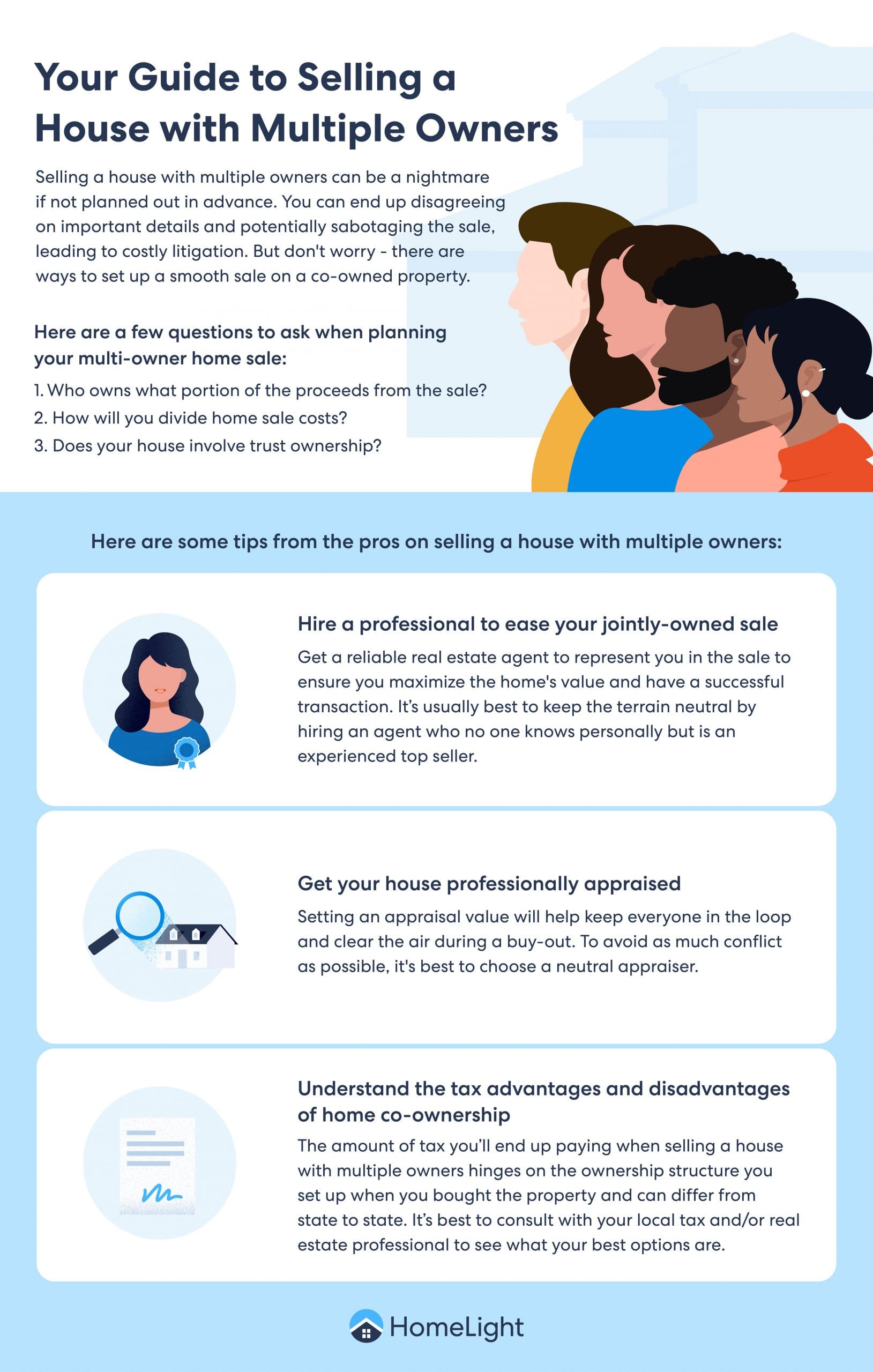
Before you buy your home with multiple owners, it’s absolutely critical that you plan for selling a house with multiple owners. Waiting until you’re ready to sell to settle disputes can create disastrous disagreements, sabotage your eventual sale, and even lead to costly litigation. “In reality, a lot of the concerns that come up as you sell a property with multiple owners should be thought out when you purchase it,” Herzberg stresses. “That’s the best way to handle it.”
Here are a few questions to ask if you want to plan your multi-owner home sale before that initial purchase:
- Who owns what portion of the proceeds from the sale?
As we mentioned earlier, not all types of co-ownership titles will divvy out the property based on an individual’s contributions. And if one owner ends up putting in extra time or money than others, it may not be reflected in the final equity agreement. That’s why it’s critical to establish who owns what portion of the property, and how much everyone should be given when the home sale closes.
- How will you divide home sale costs?
Selling any home takes hard work, and that process can come at a price. If you haven’t decided who will pay for what home sale preparations early on, you could see fellow homeowners back out of your sale in the middle of the process. Here are a few expenses to consider before selling a house with multiple owners:
- Staging costs
- Taxes, attorneys, and fees
- Repairs and maintenance
- Home upgrades
- Utilities and bills during the sale
- Does your house involve trust ownership?
Creating a living trust is a good way to hand a real estate asset over to a child after a parent passes away — achieving estate tax protection and avoiding probate in the process. During this process, you generally set up a trust and a trustee who manages the home for an eventual beneficiary or beneficiaries. To sell a trust ownership, Herzberg says you’ll need to give the person who is conducting the closing a copy of the trust or a Certificate of Trust that states who has the power to sell. He also suggests having the authority for the trust available for the closing. As long as you’ve buttoned down those details, you should be ready for a smooth transaction. “As long as the trust is clear on who has the authority, it’s not all that complicated,” Herzberg says.









 English (US) ·