
As a homeowner, every mortgage payment you make is an investment in yourself. Even if only a small portion of it goes toward your principal loan balance, it’s typically better than paying rent. If you were to sell your home today, how would your investment stack up against the average house price in the USA?
In this post, we’ll look at what the current numbers look like, how house prices have changed over time, and how to get a more personalized estimate for your property.
How Much Is Your Home Worth Now?
Home values have rapidly increased in recent years. How much is your current home worth now? Get a ballpark estimate from HomeLight’s free Home Value Estimator.
What’s the average house price in the USA?
As of this publication date, the average house price in the U.S. is $514,600, based on the latest data from the U.S. Census Bureau and the U.S. Department of Housing and Urban Development. This number reflects what homes are selling for on average across the U.S., giving you a general idea of the market. However, actual home prices can vary widely depending on the location, property type, and local market dynamics.
Keep in mind that the average price is different from the median home price, which is currently $403,200. The average can be skewed by a small number of expensive home sales, especially in places like California or New York. But it’s still useful for getting a broad sense of where the housing market stands across the country. (We’ll look more closely at average vs. median prices in a minute.)
How has the average house price in the USA changed?
Home prices have come a long way over the past few decades, with the biggest jumps happening in the last five years. Back in 2000, the average house price in the U.S. was $212,100. By 2010, even after the housing crash, it had risen to about $278,000, and by 2020, it had reached roughly $396,900. Then the pandemic housing boom pushed prices even higher. By the end of 2025, the average house price had climbed to $541,300, an increase of about 155% over the past 25 years.
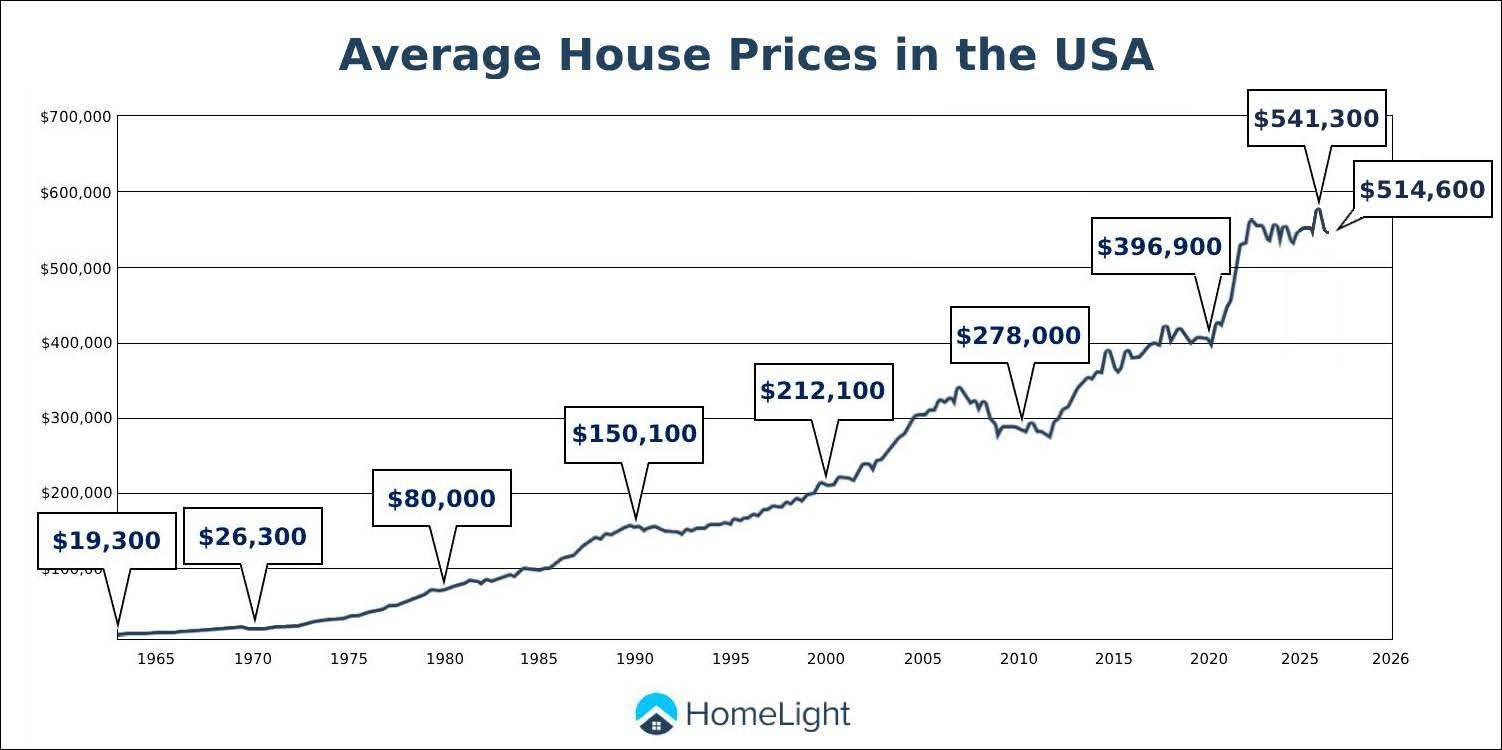 Source: U.S. Census Bureau; U.S. Department of Housing and Urban Development
Home prices in the U.S. have been pushed up by a mix of low housing supply, strong buyer demand, low interest rates, and inflation. The COVID-19 pandemic also played a big role, with record-low mortgage rates (around 2.65% in January 2021) and more people moving or working remotely, which drove prices higher in many areas.
More recently, price growth has slowed a bit as mortgage rates have gone up, but home prices are still much higher than they were in past decades.
Average house price vs. median home price
As you compare house prices to your own home, it helps to know the difference between average and median values. Here’s a quick refresher from math class:
- Average house price is calculated by adding up all the sale prices and dividing by the number of homes sold. This metric can be useful for seeing overall trends in the market, but it can be skewed by a handful of high-priced sales.
- Median home price is the middle point, half of homes sold for more, and half sold for less. It gives a more accurate snapshot of the market, especially in areas with wide price ranges.
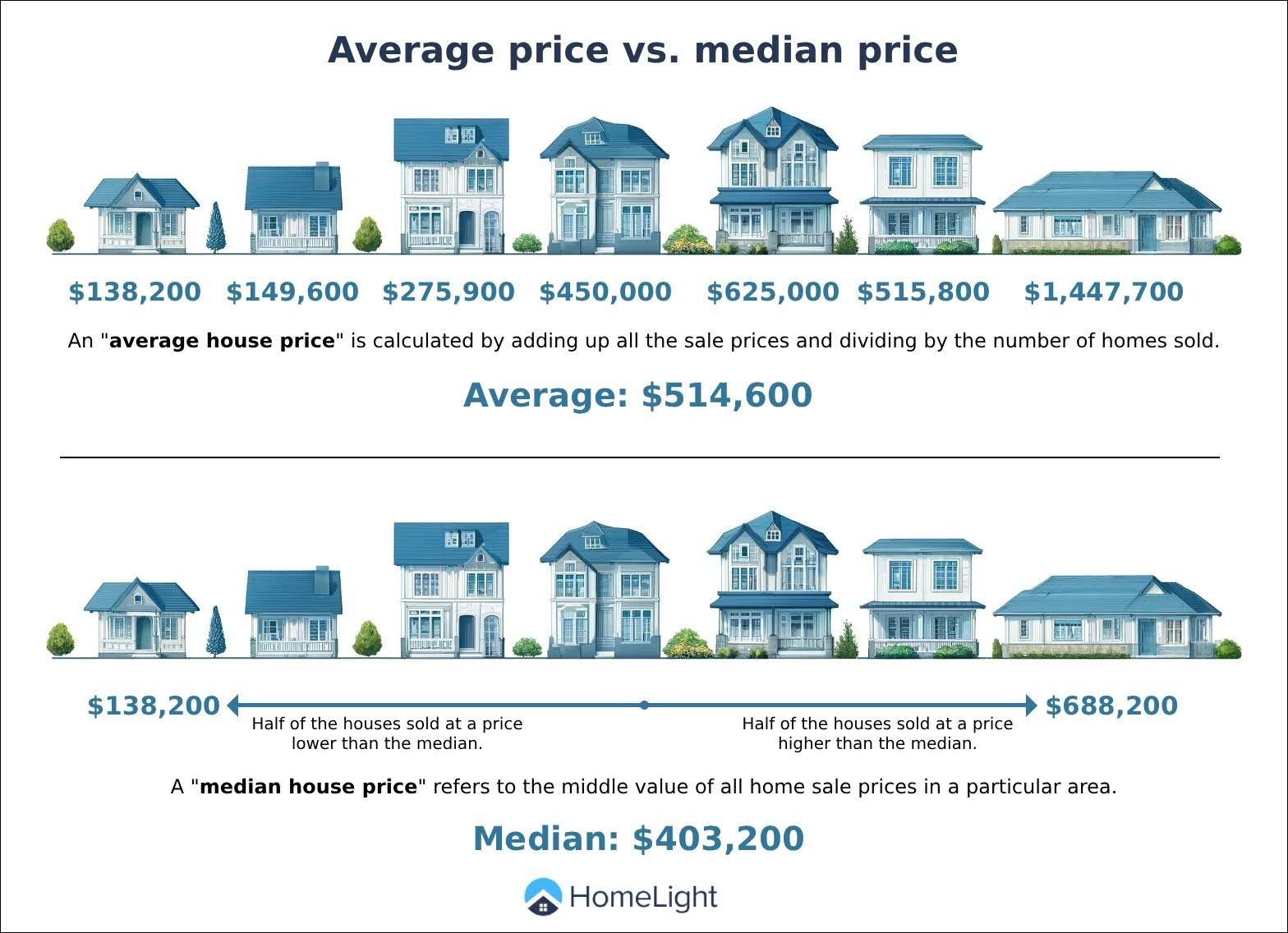
For example, while the average house price in the USA is about $514,600, the median home price is only $403,200 as of the first quarter of 2026. Median pricing can often provide a better sense of what a typical buyer or seller might expect.
How do average house prices vary by state?
Average home prices can vary a lot depending on where you live. For instance, prices in coastal states or urban centers are often much higher than those in rural or Midwest areas.
Here’s a quick snapshot of average home prices in a few states as of the first quarter of 2026, according to Zillow data analyzed by the Motley Fool Money team:
- California: $774,932
- New York: $505,237
- Texas: $301,155
- Florida: $375,536
- Kansas: $244,124
These numbers show just how much location matters in real estate. That’s why national averages only tell part of the story, and it’s more useful to look at what’s happening in your local market.
Find the average house price in your state
You can check your state’s average home value using the interactive map below:
Note: Average house prices in the USA vary depending on the source you’re looking at. For example, data from the Federal Reserve Economic Data (FRED) won’t always match figures from Zillow. Many other sources, such as the National Association of Realtors (NAR), prefer to track and report median home prices rather than averages.
What impacts average house prices in the USA?
Along with location, other factors that can influence the average house price in the USA include:
- Supply and demand: When there aren’t many homes for sale, buyers compete more, which pushes prices up. When there’s more inventory, prices tend to cool off.
- Interest rates: Lower mortgage rates make borrowing cheaper, so more people jump into the market. Higher rates usually slow demand and can take pressure off prices.
- Economic conditions: When jobs are strong and wages are rising, more people can afford to buy, which helps lift prices. A weaker economy usually does the opposite.
- Inflation: As the cost of building materials, labor, and land goes up, new and existing home prices tend to rise too.
- Population trends: Cities and regions with growing populations or lots of new jobs often see higher home prices because more people are competing for the same homes.
- Government policy: Things like zoning rules, tax breaks, and central bank rate decisions can all nudge home prices up or down depending on how they affect supply and demand.
Price Your Home Right With a Top Agent
Our agent matching platform takes into account an agent’s specialties and certifications, years of experience, and concentration of transactions in your neighborhood — helping you set an accurate price for your home sale.
How can I estimate my home’s value today?
To get a ballpark idea of your home’s value, try HomeLight’s Home Value Estimator. It uses public data, market trends, and recent sales in your area to give you a quick, preliminary estimate. While it’s not a formal appraisal, it’s a smart (and free) starting point if you’re thinking about selling or just curious about where you stand.
If you’re keen on putting your home on the market, you can use HomeLight’s Net Proceeds Calculator below to estimate how much you might make from a sale after costs like agent commission, closing costs, and mortgage payoff.
Ask a top agent for a CMA to price your home
If you’re serious about selling, your next step is to connect with a top local agent. A trusted real estate agent can provide a comparative market analysis (CMA), a detailed report that looks at similar properties in your area, recent sales, and current listings to help you price your home right.
HomeLight can match you with a top-performing agent in your area who knows your local market inside and out. With the right agent and accurate pricing, you’ll be in a strong position to sell your home quickly and for top dollar.
Frequently asked questions (FAQs) about average house prices
Average home price is simply all prices added up and divided by the number of homes sold. Median home price is the middle point where half sold for more and half sold for less. Median is usually more “realistic” because a few expensive homes don’t skew it as much.
There are a few major reasons, including limited housing supply, high demand, and rising construction costs. Low interest rates in recent years also pushed more buyers into the market, which drove prices up. Add inflation and population growth in certain areas, and prices climb even more.
Hawaii tops the list with the highest average home price in the country at $832,071. It’s mainly because land is limited and demand is high, especially in desirable areas. California also consistently ranks near the top for the same reasons, with an average of $774,932 as of the first quarter of 2026.
States like West Virginia, Mississippi, and Louisiana have some of the lowest average home prices in the country. West Virginia averages about $173,639, Mississippi around $191,526, and Louisiana about $210,576. These prices tend to be lower because demand is weaker in many areas, and local job markets and wages are generally lower than in other parts of the country.
It depends on where you live, but many experts suggest your home should cost about three times your annual income. With higher interest rates today, buyers often need a higher income than they did a few years ago. In expensive areas, you may need well over $100K a year to afford a starter home.
Header Image Source: (Jane Sorensen / Unsplash)







 English (US) ·