
Why PropTech Platforms Need an STR Regulations API
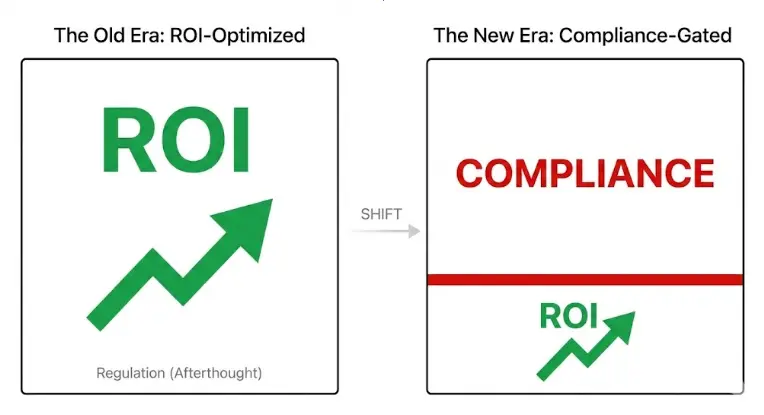
For nearly a decade, short-term rental (STR) investing operated like a digital gold rush. Investors optimized for nightly rates, occupancy curves, and platform algorithms. If the numbers worked, the deal worked. Regulation was an afterthought, a checkbox buried somewhere between financing and furnishing.
That era is over.
Today, STR regulation is no longer a minor legal hurdle. It is a terminal underwriting risk. A single city council vote can eliminate non-owner-occupied rentals overnight. A newly enforced permit cap can freeze new supply instantly. An aggressive enforcement cycle can quietly collapse occupancy across an entire zip code.
In this environment, yield without legality is an illusion. For PropTech platforms, marketplaces, analytics dashboards, and STR lending engines, this shift changes everything. Compliance can no longer live in a blog post or a manual research step. It must become a programmatic underwriting input.
The API as a Policy Enforcement Engine
In the context of real estate compliance, an API is more than just a bridge for data; it is the infrastructure for automated policy enforcement. When we talk about “staying compliant by city,” we are talking about the ability to translate thousands of local municipal codes into a single, executable logic gate.
Deterministic vs. Probabilistic Data: The Compliance Threshold
One of the most critical distinctions in real estate technology is the difference between probabilistic modeling and deterministic data. Most PropTech platforms have historically relied on probabilistic data, estimations, inferred classifications, and Automated Valuation Models (AVMs). In the context of ROI, an “estimate” is often acceptable. In the context of compliance, an estimate is a liability.
Probabilistic data relies on “likelihoods.” It might infer a property is a single-family home based on its square footage or neighborhood profile. However, if a city ordinance explicitly bans STRs in multi-family units but allows them in single-family homes, “likely” isn’t good enough.
Deterministic data, on the other hand, is backed by authoritative records, tax assessments, deed filings, and official land-use codes. For a platform to serve as a true underwriting tool, its API must provide these deterministic metadata points. Compliance requires a binary “Yes” or “No” based on legal truth. When a platform relies on inferred data for compliance, it exposes its users to catastrophic capital risk. If an institutional investor deploys $50M into a market based on “probable” eligibility, and that metadata is wrong, the entire portfolio’s cash flow can be wiped out by a single enforcement letter.
The “Ghost Listing” Problem and Enforcement Signals
Standard real estate APIs also struggle with the “Ghost Listing” problem. In markets undergoing aggressive regulatory crackdowns, thousands of listings may remain “active” on booking platforms even after their legal permits have been revoked.
If a platform only tracks active listings, it might report a healthy, thriving market. In reality, that market could be in the middle of a “supply contraction.” A compliance-aware API must provide more than a snapshot; it must provide historical performance trends. By cross-referencing a sudden drop in supply with sustained demand, platforms can detect an “enforcement signal.”
For example, if the number of active rentals in a specific zip code drops by 40% in a single quarter while nightly rates remain high, it is rarely a sign of market failure, it is a sign of a regulatory “clean sweep.” Platforms that can programmatically identify these signals allow their users to avoid entering markets where the “door is closing,” even if the current ROI looks attractive.
Turning Ordinances Into Logic
To automate compliance, platforms must translate messy legal language into structured, queryable data. At a practical level, most STR regulations fall into three operational “guardrails.”
1. Zoning & Property-Type Restrictions
Many cities restrict STRs by building classification. Using property-level metadata, a platform can automatically flag ineligible property classes or exclude restricted asset types from search results. This ensures the user only sees legally viable inventory.
2. Residency & Ownership Mandates
A growing number of cities allow STRs only if the property is owner-occupied. By leveraging ownership indicators within the property dataset, a platform can transition from “ROI modeling” to “operational viability modeling.” This is the difference between a tool that tells you what you could earn and a tool that tells you what you’re allowed to earn.
3. Market Saturation & Permit Caps
Some cities regulate through hard permit caps. While ordinance databases define the official limits, performance trends reveal real-world enforcement patterns. This is where the platform moves from static data to predictive risk modeling.
Technical Architecture: Building the Compliance Layer with Mashvisor
If compliance is an underwriting input, it must live inside the platform’s architecture. By leveraging Mashvisor’s structured data, platforms can feed their own validation frameworks.
A compliance-aware underwriting engine can be built by combining several Mashvisor API endpoints that expose deterministic property metadata and historical rental performance.
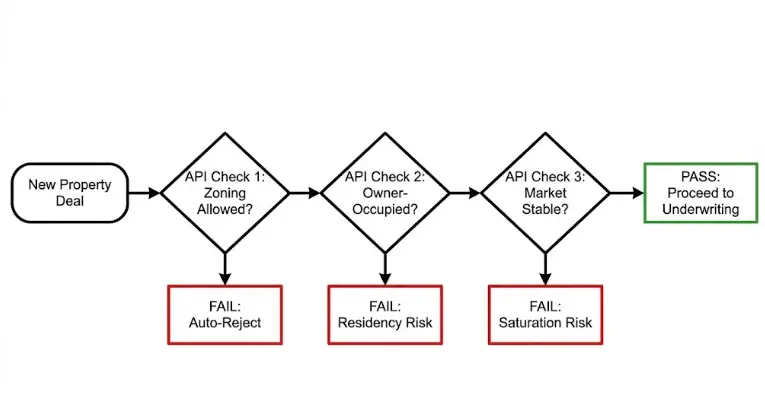
Phase 1: The Eligibility Filter (Property Info)
Endpoint: GET /v1.1/client/property
This is the foundational data pull. When a user selects a listing, the platform retrieves the Property Object.
- Key Fields: property_type, home_type, and occupancy_status.
- The Logic: If a city prohibits multi-family STRs and the API returns property_type: Multi Family, the system triggers a flag. This ensures underwriting only proceeds on legally plausible assets.
Phase 2: Ownership & Residency Screening (Property Ownership)
Endpoint: GET /v1.1/client/owner/contact
Where cities require primary residence status, the platform evaluates ownership indicators found in the Property Ownership section of the API.
- The Logic: By pulling the owner’s contact and address data, the system compares the owner’s mailing address with the subject property address.
- The Action: Instead of silently calculating returns on a restricted asset, the platform surfaces a visible “Residency Risk” warning.
Phase 3: Regulatory Pressure Detection (Rental Activity Data)
Endpoint: GET /v1.1/client/rento-calculator/historical-performance
Static rules capture what is written; trend data captures what is happening.
- The Signal: By analyzing metrics like active listing counts and occupancy trajectory over time via the Rental Activity Data section, a platform can detect abnormal supply contractions that signal enforcement cycles.
Case Study: Institutional Underwriting for a Multi-Market REIT
Example: Institutional STR Underwriting Workflow
Consider a Real Estate Investment Trust (REIT) targeting the Florida market, specifically Miami, where city-level ordinances are dynamic and carry heavy fiduciary implications. For a REIT, compliance isn’t just a legal goal; it is a capital markets requirement. Their investment committee (IC) requires an audit-traceable risk framework before a single dollar of institutional capital is deployed.
Step 1: The Metadata “Gateway”
The system begins by querying GET /v1.1/client/property to retrieve the high-fidelity Property Object. In a traditional workflow, an analyst would spend hours on a city’s GIS website. Programmatically, the system checks property_type and occupancy_status in milliseconds. If the property is flagged as a “Second Home” in a zone requiring primary residency, the deal is killed before it even reaches the analyst’s desk.
Step 2: Ownership & Residency Verification
The platform verifies the owner’s details via GET /v1.1/client/owner/contact.The engine extracts the mailing address of the owner and cross-references it with the subject property’s address. For a REIT, this programmatic check is vital for scale. When evaluating a 50-property portfolio, manual verification is impossible. The API provides the deterministic proof required for the IC memo.
Step 3: Market Contraction & Enforcement Analysis
The platform queries GET /v1.1/client/rento-calculator/historical-performance. If the data shows a sharp decline in active listing counts, the REIT identifies a “Regulatory Pressure” signal. This allows the REIT to pivot its capital to more stable micro-markets, preserving capital in the face of municipal volatility.
Step 4: Output — The Unified Underwriting Score
The platform aggregates these Mashvisor data points into its own decision engine:
| Metric | Mashvisor API Source | Value |
| Projected ROI | Investment Analysis | 8.2% |
| Zoning Match | Property Info (property_type) | Pass (Single Family) |
| Residency Match | Property Ownership (mailing_address) | Fail (Absentee Owner) |
| Market Pressure | Historical Performance Trends | High (Supply contraction) |
The Result: The system generates a “No-Buy” signal. This programmatic workflow ensures that every deal in the pipeline meets the REIT’s strict fiduciary standards for operational certainty.
Compliance as a Fiduciary Guardrail
As short-term rentals mature from opportunistic retail plays into institutional asset classes, the demand for repeatable risk frameworks has shifted from a “nice-to-have” to a capital markets requirement. For institutional funds, compliance is the ultimate fiduciary guardrail.
Lenders and capital partners are increasingly sensitive to “regulatory drift”, the phenomenon where an asset is purchased under one legal framework but becomes “orphaned” by another. In this high-stakes environment, a platform’s reliance on manual research or “best-effort” disclaimers is a non-starter. Institutional underwriting requires an audit-traceable data lineage. By leveraging deterministic property metadata, platforms provide a digital paper trail for every investment decision. When a lender asks why a specific asset was approved for a high-leverage loan, the platform can point to the specific Mashvisor-backed occupancy_status and property_type indicators that matched the city’s ordinance at the time of underwriting. This transforms compliance from a legal burden into a liquidity feature, making assets more attractive to risk-averse institutional buyers.
Conclusion: From ROI to Operational Viability
The short-term rental market has moved past its “growth at all costs” phase. In this new landscape, the most sophisticated calculation is no longer how much a property could make, but whether it is allowed to exist. For PropTech platforms, this shift represents a fundamental change in product category.
By integrating deterministic property metadata and real-time performance signals directly into the underwriting workflow, platforms move beyond being simple ROI calculators. They become essential risk infrastructure, tools that protect capital, ensure fiduciary compliance, and provide the operational certainty that institutional investors demand. As regulation continues to tighten, the platforms that encode legality into their technical architecture won’t just survive; they will define the next era of real estate investing.
Scaling Compliance in Your Real Estate Data Stack?
If you’re evaluating how to integrate structured property metadata into your underwriting engine or transition from manual research to a programmatic compliance workflow, we’re happy to pressure-test your architecture.
Book a short intro call with our data team to walk through your specific use case, technical requirements, and how to leverage Mashvisor’s API to build a compliance-aware roadmap.


 English (US) ·