
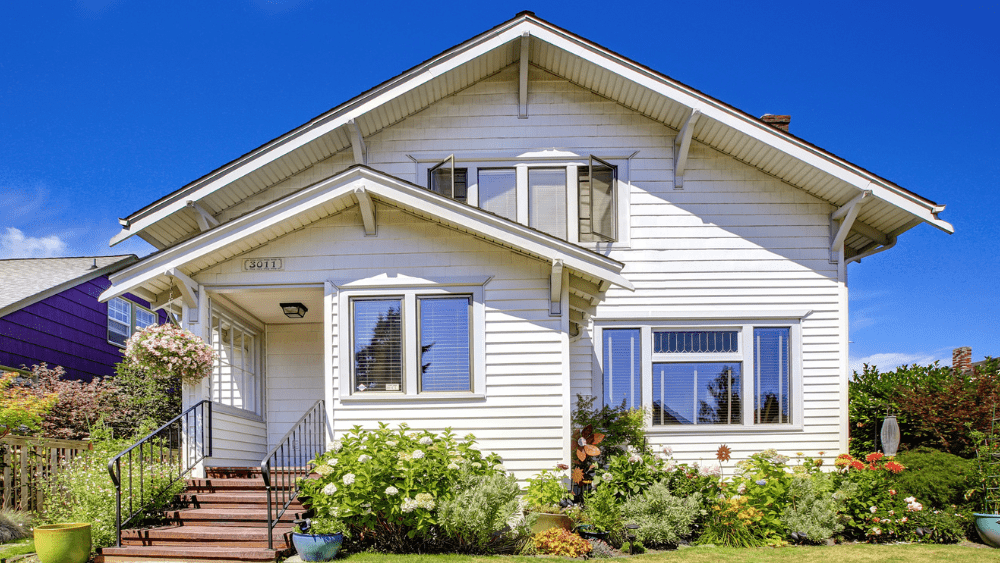
When Tina LaMonica and Warren Wellen purchased their South Pasadena Craftsman home in 2001, the one-car garage dated back to 1917, a time when people parked their narrow Ford Model T cars inside garages like this one.
“We bought it for $650,000,” LaMonica says of the house. “Of course, we could never afford to buy it now.”
The couple moved in when their daughters, Sophie and Ruby Wellen, were little, and their tree-lined street was full of families with young kids who rode their scooters throughout the neighborhood.
“We all grew up together and had block parties,” says Sophie, 30. Now, she adds, “There are no new families moving in. No one left. Why would they?”

Tina LaMonica and Warren Wellen sit on the patio with their daughter, Sophie Wellen, and their dog, Hazelnut, next to the 230-square-foot ADU where Sophie lived for two years. Her younger sister is now living in the ADU.
Music was always a part of their home, Sophie says, thanks to her father, Warren, 65, who is both an attorney and a musician in the alternative rock band Brahms’ Third Racket.
“He plays everything,” Sophie says. “Throughout my entire childhood, he was always making music.”
LaMonica adds, “It can be disruptive.”
So in 2021, the couple pulled together money from different sources, including a line of credit, and turned the garage into a tiny 230-square-foot accessory dwelling unit, or ADU, for Warren to use as a music studio.
“It was intended to be a creative space, not a home,” says LaMonica, 64, who is a commercial real estate broker. “The total cost was around $125,000, including permits, construction and all systems — a significant investment, but one that ended up serving our family in unexpected ways.”


The garage before, left, during, right, and after, below, construction. (Tina LaMonica)

A few months after using his new music studio, Sophie, who had been in law school at the University of Michigan, moved back to Los Angeles after being away for 10 years.
“She wasn’t working right away, and like many new grads, she had student debt and credit card debt from getting through school,” says LaMonica. “Market rent in the Los Angeles area wasn’t realistic, even with a job offer lined up. So, the studio became her first home. It gave her stability and independence during a major transition.”
Sophie, who describes her relationship with her parents as close, says the ADU was always meant to be temporary and she’s grateful for it.
“At 28, I didn’t know where I wanted to live in L.A.,” she says. “I had only grown up in Pasadena, which is a small community. I felt lucky to be able to live in this little house in the back and explore the city to find the right place for me, instead of rushing to grab the first place I could, like so many of my associates had to do. It was right after the bar exam, and I was really stressed.”

The ADU features a Murphy bed and and a nice-sized kitchenette.

The kitchenette has a compact air fryer-toaster oven from Our Place, and a slim, Classic retro-style refrigerator.
After clerking for a judge in Washington, D.C., Sophie’s boyfriend William Lang moved to Los Angeles and joined her and her dog in the ADU, bringing his two cats with him.
“It was a full house,” Sophie says, laughing. “And yes, they were indoor cats! But we made it work. Finding a rental was hard. I couldn’t really afford a nice apartment in L.A. I had to save up and wait until my boyfriend got here so we had two incomes.”
It’s no surprise they felt at home. Although it’s small, the unit is sunny and bright, with a pitched roof and a big picture window overlooking the lush backyard and swimming pool. (The blinds can be closed for privacy.)
There’s a Murphy bed that turns into a love seat when pulled down, which saves space, and classic black-and-white checkerboard porcelain tile from Mission Tile in South Pasadena that gives the living spaces a surprising sense of fun. The unit also has a bathroom with a shower, a closet and a storage nook above the bathroom.

The ADU has room for a desk, flat-screen TV and comfy chair.
There’s also room for a desk, a flat-screen TV on the wall and a comfortable chair. Not having a dining room isn’t a problem because there’s a welcoming patio just outside the French doors, with two chairs, a couch and a coffee table.
“The backyard was our saving grace,” says Sophie. “Most of the time, William sat at the little table. It was cozy and nice. I got to be near my parents, and they got to know my partner better.”
The ADU has a roomy kitchenette with white cabinets and countertops, a compact air fryer-toaster oven from Our Place, and a slim retro-style refrigerator from Unique. “You can bake, broil and fry with the small Wonder Oven,” LaMonica says. “Ruby uses it all the time.” There’s also a mini-split system for heating and cooling, and if needed, a stackable washer and dryer can be added later.

A patio area provides another living space steps outside the ADU.
Soon after Sophie moved out, having lived in the back house for two years, her 27-year-old sister Ruby moved in. “She works in Torrance and can’t afford to rent an apartment close to her job,” her mother says. “The ADU gives her a chance to live affordably, stay safe and be near family, while building financial footing on her own terms.”
LaMonica is happy with the ADU, though she wishes they could have added a second floor, which the city of South Pasadena didn’t allow at the time.
She imagines a future in which one of her daughters lives in the main house, and she and her husband live in the ADU. “I think an ADU is a great long-term solution,” she says. “It keeps people from moving out of California. With an ADU, at least you can keep your family on site.”
In some ways, the small ADU is more than just a solution for young people who can’t afford to live in Los Angeles. A 2025 study found that Los Angeles ranked second among the 50 largest U.S. metros for its share of working adults (ages 25 to 40) living with parents.
Backyard homes can also help people connect with their community.
“The nice thing about the ADU is that it can give you a sense of community that’s hard to find right now because people are so isolated,” says Sophie, who now rents a two-bedroom duplex in Hancock Park with Lang for $4,500 a month. “We’re both lawyers at private law firms and doing well, but I still don’t feel like I could have a child right now and give them the life I want. It’s hard to make big life decisions in L.A., especially if you have student debt. It was really nice to have dinner with my parents every once in a while. They didn’t want William and I to leave.”

The bathroom inside the ADU.
As Southern California gets more crowded and housing costs rise, young people have to look for options different from those their parents had when they were growing up.
LaMonica says she and her husband never thought they would house both daughters in a converted garage. “But in a place like Los Angeles,” she says, “the tiny ADU turned into a flexible and essential lifeline for our family, not just once but twice.”
And maybe one day, Warren will finally get his music studio.



 English (US) ·