
For real estate professionals evaluating data solutions, pricing is often the deciding factor after reviewing features and datasets. Investors, PropTech companies, and analytics teams need clear visibility into the expected costs before integrating an API into their workflows, especially when planning for scalability and long-term usage.
To address this critical issue, the Mashvisor API pricing is structured in a way that provides clarity through a flexible, usage-based model rather than fixed monthly licensing fees. By aligning costs with actual data extraction, the pricing structure supports a wide range of use cases – from investment property analysis and real estate underwriting to short-term rental revenue modeling and DSCR checks. Ultimately, this model allows professionals and businesses to scale their data access efficiently as their needs grow over time, without overpaying.
Key Takeaways
- Mashvisor offers flexible monthly and annual API plans starting at $129/month, with pricing based on usage volume rather than restrictive data licensing.
- The four API tiers support different levels of data usage, with monthly API call limits designed for startups, analytics platforms, and large-scale real estate applications.
- All plans include full endpoint access and documentation, while higher volume or specialized use cases can be supported through custom packages available after a demo consultation.
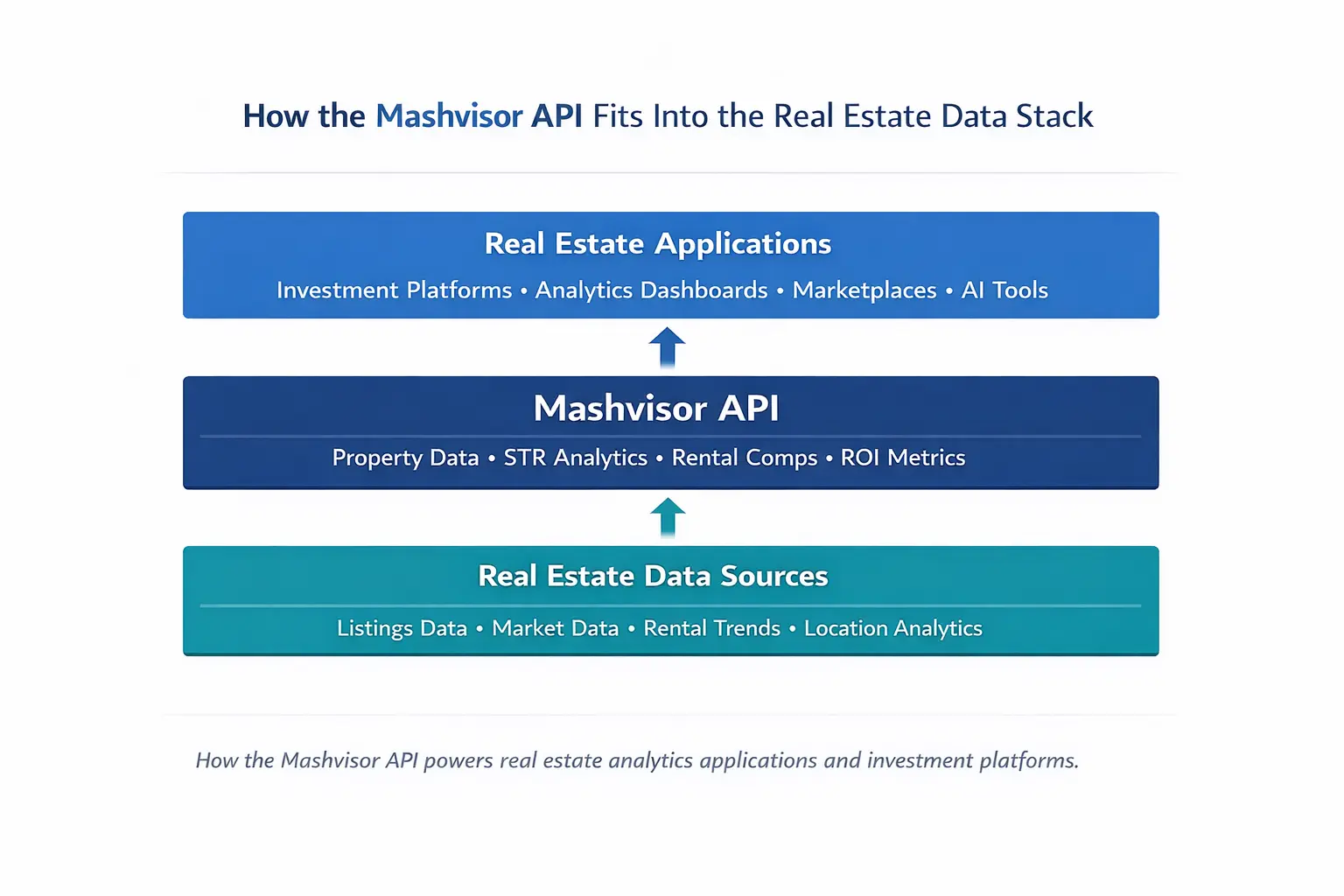 How Mashvisor API Pricing Works
The Mashvisor API pricing model is designed to balance transparency and flexibility, which allows businesses to access the exact amount of real estate data that they need without committing to a fixed monthly cost. Mashvisor offers a usage-based structure instead of typical fixed data packages where users often end up overpaying. This approach to pricing makes the API cost suitable for a variety of users, from early-stage startups to established real estate analytics platforms operating complex workflows.
Both monthly and annual subscriptions are available, with annual plans offering months of free access per year, adding extra value. API access starts at about $129/month for small-scale users. The exact pricing depends on usage requirements and is finalized during a demo consultation. This ensures that you understand exactly how the Mashvisor works and that the selected plan meets your company’s specific needs.
Credit-Based Pricing Model Explained
The Mashvisor API cost model follows credit-based pricing where use gets measured through API calls that are tracked on a monthly basis. Each request that you make to an endpoint consumes part of the monthly plan’s allocation.
Unlike traditional real estate data licensing agreements, which require a large upfront commitment, this structure makes it possible to start with small workloads and expand gradually.
All plans include full access to the Mashvisor API documentation and all available endpoints. So, functionality is consistent across pricing tiers, while usage capacity scales according to monthly call limits.
In this way, professionals and enterprises can get the data they need for market research, investment property analysis, rental comps intelligence, and Airbnb performance modeling without forcing users to pay for unused data access.
What Affects API Pricing
There are a number of factors that affect the final Mashvisor API cost. It’s important for businesses to understand the impact of these variables to be able to estimate the total cost before getting started.
The main indicators that drive the Mashvisor real estate data API pricing include:
- Monthly API request volume: Platforms performing large-scale market scans or recurring automated analysis need higher call allocations.
- Data depth and analytics needs: Accessing LTR and SRT historical performance API or running ongoing investment analysis increases usage and cost over time.
- Integration scope: Internal research and analytical tools usually demand fewer data requests than customer-facing apps or SaaS dashboards.
- Business scale and growth expectations: Teams often select plans based not only on their current usage but also on expected expansion.
As pricing varies widely depending on how you use the available datapoints, Mashvisor offers flexible packages and custom options to fit the needs of both small startups and large enterprises. In this way, you can align the price that you pay with the measurable business outcomes that you get out of it.
The best way to estimate the total cost that you can expect for benefiting from the Mashvisor API is to talk to our Data Experts. Schedule a free demo to select the right plan for your business needs.
After understanding how Mashvisor API pricing works in theory, let’s take a look at how this structure translates into practical subscription tiers designed for different levels of usage.
Mashvisor API Pricing Tiers (Examples & Typical Ranges)
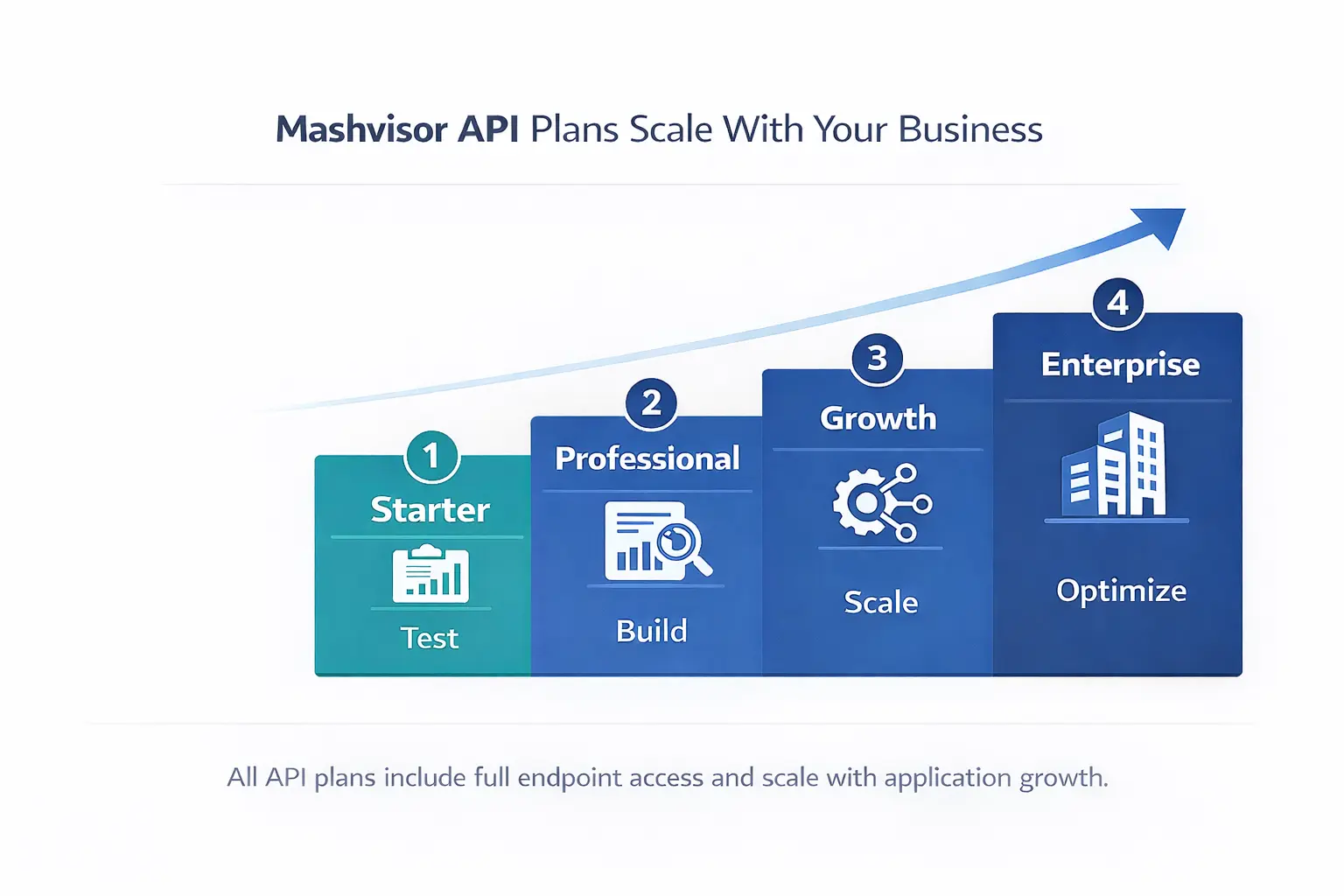
Mashvisor offers four API plans designed around monthly request volume. The main difference between the subscription plans is the number of API calls allocated, allowing businesses to choose the tier that matches their operational scale. Meanwhile, with all plans to get access to all endpoints and full documentation.
The table below summarizes the four Mashvisor API pricing tiers for an easy visualization:
Mashvisor API Pricing Tiers: Comparison
| Plan | Best For | Monthly API Calls | Typical Users | Common Use Cases |
| Starter | Testing & validation | 500 | Investors & developers | Testing & prototypes |
| Professional | Growing analytics tools | 1,000 | Small startups | Analytics dashboards |
| Growth | Scalable platforms | 3,000 | SaaS products | Production analytics |
| Enterprise | Large-scale apps | 10,000 | Large platforms | Marketplaces & underwriting |
How to Choose the Right Tier for Your Needs
Selecting the most appropriate Mashvisor API plan should be mostly guided by how frequently your application accesses data and how deeply analytics are integrated into your workflows.
The following guidelines can help you estimate which tier might be the best starting point:
- Start with expected request volume: Estimate how many API calls your application will make monthly, including automated analysis, repeated searches, and user-triggered queries.
- Consider how the data will be used: Internal research tools and testing environments require fewer calls than customer-facing platforms and real-time analytics dashboards.
- Plan for growth, not just current usage: Choosing a tier that provides room for scaling helps avoid disruptions as integrations expand or usage increases.
- Evaluate automation frequency: Applications that run scheduled analysis, market monitoring, or recurring investment calculations generally demand higher call allocations.
- Align with integration stage: Prototype projects tend to begin with smaller tiers, while production systems and commercial platforms usually require Growth or Enterprise-level capacity.
If you’re wondering which plan to go for, remember that Mashvisor offers maximum flexibility. You can start with one tier and move to the next as soon as your needs change.
While pricing tiers define usage capacity, the real value of the Mashvisor API becomes clearer when looking at how businesses apply this data in real-world scenarios.
Real Mashvisor API Pricing Use Cases
Trusted by proptech startups, STR operators, and real estate analytics platforms
Used for: Underwriting, DSCR checks, comps, STR revenue modeling
The Mashvisor real estate API pricing tiers are structured based on how actual businesses use market and property data in production environments. In this way, companies scale access according to their operational workflows, whether analyzing individual rental properties or powering large analytics platforms.
The following examples illustrate how different organizations match API access to specific business goals.
Investment Property Analysis Apps
PropTech platforms and investors tools use the Mashvisor API to automate rental property analysis, calculate expected returns (whether cash on cash return or cap rate), and compare investment opportunities across multiple markets. Instead of collecting and organizing data manually, apps can retrieve rental estimates, property metrics, and market insights programmatically, through the best real estate data API.
This type of workflow involves recurring queries as users search markets or evaluate listings, making usage-based pricing particularly effective for investment property analytics.
Sample Property Data API Request
GET /property?address=Miami&state=FL
Authorization: Bearer API_KEY
Short-Term Rental Revenue Modeling
STR platforms and analytics teams use the Mashvisor Airbnb data API to model short-term rental performance, forecast revenue potential, and evaluate market demand and supply trends. Access to historical performance data allows apps to estimate Airbnb occupancy rates and average daily rates (ADR) across locations.
Because this type of analysis often runs automatically across numerous properties, Airbnb API usage scales naturally along with business growth. The Mashvisor Airbnb data API pricing aligns with this reality.
Sample Airbnb Historical Performance Data API Request
GET /airbnb/historical-performance?city=Austin
Learn more about the Mashvisor Airbnb occupancy rate API, as one of the main metrics determining STR revenue.
DSCR and Lending Underwriting Automation
Lenders and FinTech platforms integrate real estate data APIs to support underwriting flows and DSCR calculations. By programmatically retrieving rental income estimates and comparable property data, teams can reduce manual analysis while standardizing investment evaluations and underwriting real estate processes.
For investment property lenders, API usage increases with loan volume, making scalable property data API pricing models beneficial for underwriting automation.
Sample API Request to Fetch Rental Estimates for Underwriting
GET /rental-estimates?property_id=12345&strategy=traditional
Authorization: Bearer YOUR_API_KEY
Accept: application/json
Use the returned rent estimate to compute NOI and run a DSCR check inside your underwriting model.
Rental Comps Analysis and Market Benchmarking
Real estate investors and analytical PropTech platforms rely on comparable real estate and rental data to evaluate pricing and validate investment assumptions. The Mashvisor API enables such apps to retrieve comparable property performance and neighborhood-level benchmarks programmatically, helping users assess whether projected returns align with local market conditions.
Real estate and rental comps analysis runs repeatedly across multiple properties and markets, and usage-based API pricing allows businesses to scale workflows efficiently, without committing to fixed data packages.
Sample API Request Retrieving Rental Comps Data
GET /rental-comps?property_id=12345
Real Estate Marketplaces and Data Platforms
Property marketplaces and analytics platforms make use of the Mashvisor API to enrich listings with investment insights, neighborhood analytics, and rent projections. These integrations require continuous background queries that update data dynamically as users browse properties.
For this type of businesses, usage grows with platform adoption, supporting long-term expansion without major pricing restructures.
Sample API Request Enriching a Property Listing With Investment Metrics
GET /property/analysis?address=Miami&state=FL&strategy=airbnb
Authorization: Bearer YOUR_API_KEY
Accept: application/json
This request retrieves investment analytics for a specific property, allowing platforms to enrich listings with metrics such as estimated rental income, occupancy rate, and projected ROI.
While these examples represent some of the most common ways businesses use the Mashvisor API, the platform supports a much wider range of applications. Teams also integrate the API into market research tools, automated investment screening systems, portfolio monitoring dashboards, and custom real estate analytics solutions, adapting data access to their specific operational and product needs.
To better understand the advantages of this pricing structure, let’s compare Mashvisor’s approach with other widely used real estate data providers.
How Mashvisor API Pricing Compares to Other Real Estate Data APIs
When evaluating real estate data API pricing, it’s useful to understand how the Mashvisor API pricing model compares with other well-known providers. Platforms like Zillow and AirDNA offer valuable datasets, but they are designed for different primary purposes, which affects how the cost and access are structured.
While Zillow focuses on property lookup and listing data, AirDNA specializes in short-term rental analytics. Meanwhile, Mashvisor combines property records, rental analytics, comps, and performance trends into a single unified API.
This difference influences not only the available datasets but also how businesses scale data usage and costs over time.
The following table compares the investment property API pricing offers by these three main providers:
Real Estate Data API Pricing Model Comparison
| Mashvisor | Zillow | AirDNA | |
| Best For | Investment platforms, Property search, analytics tools & listing apps | Property search & listing apps | STR operators & market research |
| Primary Focus | Property listings, home values, STR & LTR analytics, comps, investment metrics | Property listings & home values | Short-term rental analytics |
| Pricing Model | Credit-based usage model | Access-restricted or partnership-based | Subscription-based market access |
| Scalability | High – scales with usage | Limited for analytics workflows | Moderate – tied to market scope |
Used by PropTech startups, STR operators, and real estate analytics platforms in production environments.
Unlike the Zillow API and the AirDNA API, the Mashvisor API combines property- and market-level data and analytics for both short-term and long-term rentals. This enables efficient rental analysis for investors and platforms relying on various strategies. Additionally, Mashvisor offers a flexible, transparent cost structure that depends on use only.
Now that the pricing structure and competitive positioning of the Mashvisor API are clear, the next step is estimating how these models translate into real costs for your specific workflow.
How to Estimate Your Mashvisor API Cost
Because Mashvisor offers a usage-based pricing model for access to the API, estimating the total API cost starts with understanding how data will be used within your workflow or app. You don’t have to worry about selecting a plan based on features as all four plans come with access to all endpoints and documentation.
The following steps provide a simple framework for estimating the likely Mashvisor API cost before requesting access.
Step 1: Define Your Data Use Case
Start by identifying how the API will support your business operations. Internal research tools, investment analysis workflows, and customer-facing analytics platforms all generate different levels of API activity.
In specific:
- Investor analysis dashboards may request data when users search properties.
- Automated underwriting systems may run scheduled analyses daily.
- Market monitoring tools may continuously scan multiple locations.
Clearly defining the use case helps establish a realistic baseline for expected usage and thus cost.
Step 2: Estimate Monthly API Requests
Next, approximate how frequently your application will call the API. Each request – whether retrieving property analytics, rental comps, or historical performance data – counts towards your monthly allocation.
Here is a simple estimation formula:
Estimated Monthly API Calls = Number of Users or Automated Jobs x Average Requests per Session x Sessions per Month
Even rough projections can indicate whether a Starter, Professional, Growth, or Enterprise plan is most appropriate in your particular situation.
Step 3: Match Your Data Needs With a Pricing Tier
Once you estimate your usage, you can align your expected request volume with the available Mashvisor API pricing tiers. Because all plans include full endpoint access, the decision primarily depends on scale rather than functionality.
Businesses often begin with a tier that supports current workloads while leaving room for growth as adoption increases or automation expands.
Step 4: Request a Custom Pricing Recommendation
After estimating usage, the final step is to request a pricing consultation. Mashvisor provides customized recommendations based on each user’s integration goals, expected data volume, and long-term scaling plans.
Exact pricing details are shared during a demo to ensure businesses select a plan aligned with real operational needs rather than generic assumptions.
Book a free demo to get personalized assistance and a custom quote.
Who Mashvisor API is Best For (and Who It’s Not)
- ✅ Best for: PropTech startups, analytics platforms, underwriting workflows, STR/LTR investment tools
- ❌ Not ideal for: One-off scraping, free data usage, or hobby projects
Not sure which tier fits your use case?
Book a 15-minute call and I’ll map your workflow to the right plan, no pressure, no upsell.
Bottom Line
Understanding API costs is crucial for businesses building data-driven real estate products or scaling investment analysis workflows. Rather than relying on rigid licensing structures, Mashvisor API pricing is designed around flexibility, allowing companies to match data access with actual usage and operational growth.
With tiered plans based on monthly API calls, full endpoint access across all plans, and customizable packages for higher-volume needs, the Mashvisor API supports a wide range of applications – from investor tools and underwriting systems to analytics platforms and marketplace integrations. For organizations seeking scalable real estate data infrastructure, this usage-based approach provides both predictability and room to grow as data requirements evolve.
If you’d like to test how the Mashvisor API works in practice before committing to a paid plan, get a 1-week free trial with 30 credits.
FAQs
How Much Does Mashvisor API Cost?
The cost of Mashvisor API plans starts at about $129/month, with pricing based entirely on monthly API usage. Exact pricing varies depending on request volume and integration needs. Businesses receive tailored pricing recommendations during a demo to ensure the selected plan aligns with their specific workflow and data requirements.
Is Mashvisor API Pricing Pay-per-Request?
Mashvisor uses a credit-based pricing model rather than strict pay-per-request billing. Each plan includes a monthly allocation of API calls, which allows teams to scale usage predictably while avoiding unpredictable per-call costs associated with some real estate data API pricing models.
Does Mashvisor Offer Enterprise API Pricing?
In addition to standard tiers, Mashvisor offers Enterprise plans designed for high-volume platforms and advanced analytics applications. Custom packages can also be created for organizations with specialized use cases, larger datasets, or higher request volumes beyond standard monthly allocations.
What Is Included in the Mashvisor API Access?
All Mashvisor API plans include access to the full documentation and all available endpoints. This covers property analytics, rental comps, investment metrics, and historical performance data used for underwriting, DSCR analysis, and short-term rental revenue modeling workflows.
Is the Mashvisor API Worth the Cost?
For businesses that rely on automated investment analysis or scalable real estate analytics, the Mashvisor API can provide significant efficiency gains compared to manual data collection or combining multiple data providers. Its usage-based structure allows companies to start small and expand access as their products or analytics needs grow.














 English (US) ·