
For many homebuyers, the excitement of finding the right house quickly turns into questions about timing, affordability, and monthly payments. Mortgage rates can swing up or down depending on the economy, inflation, and what’s happening in the housing market, making today’s rates feel confusing. Looking back at mortgage rates history, how rates have risen and fallen over time can give buyers a valuable perspective on what’s considered “high,” “low,” or simply part of a normal market cycle.
How Much Is Your Home Worth Now?
Home values have rapidly increased in recent years. How much is your current home worth now? Get a ballpark estimate from HomeLight’s free Home Value Estimator.
Ultimately, it can help you feel more confident about whether now is the right time to buy, refinance, or make a move. Maybe you refinanced during the record-low pandemic-era rates and have been reluctant to give up that mortgage, even as life changes make a move feel necessary. Or perhaps you’re wondering if today’s rates are truly high or just closer to what buyers used to consider normal. Understanding how mortgage rates have changed over time can make today’s market feel a little easier to understand.
Here’s how the past 50+ years of mortgage rates history look on a chart:
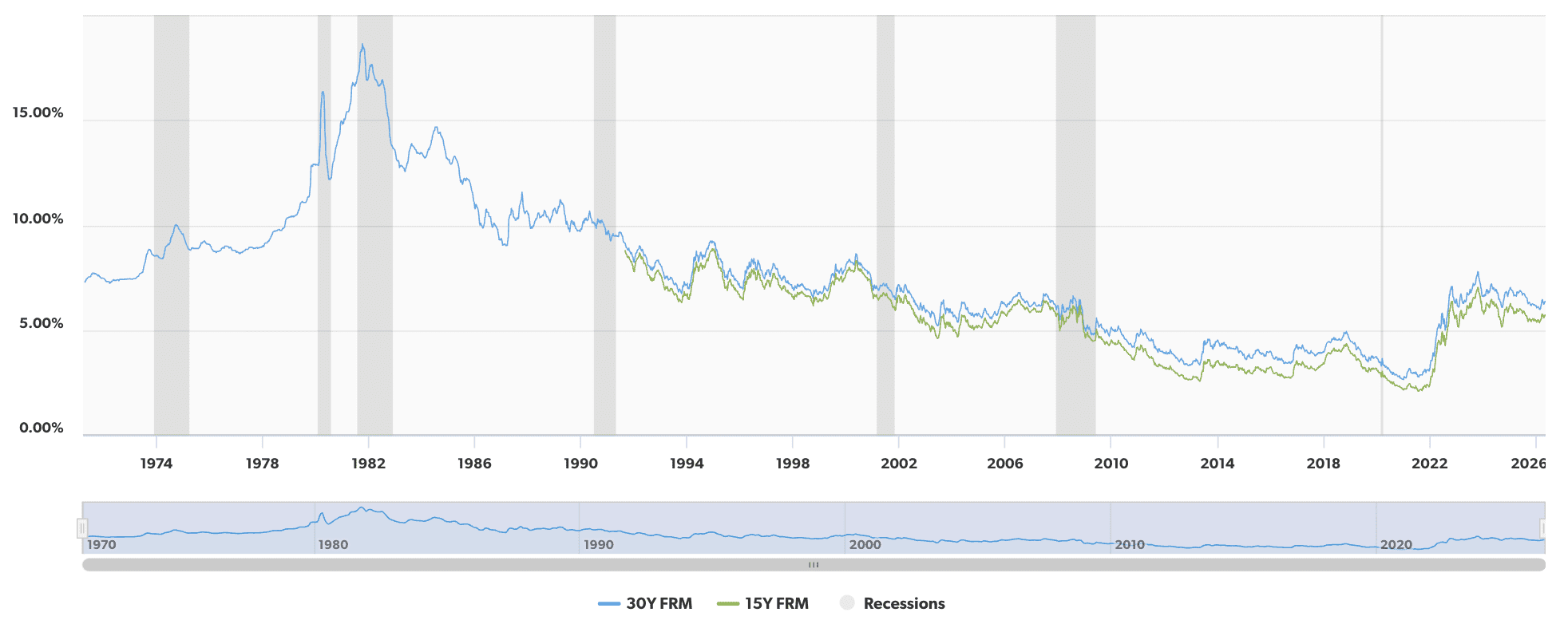
Mortgage rate trends then and now
In this section, we provide a brief overview of the trends that stood out in mortgage rates history.
Average mortgage rates in the 1970s: 7.38% to 11.20%
At the beginning of the decade, homeowners paid mortgage interest rates of around 7.38% to buy a home, but by the decade’s end, the rate had jumped to 11.20%! What caused the change? The 1973 oil embargo led to rapid inflation, which collided with layoffs and wage stagnation, causing what economists call “stagflation.” The result? Mortgage rates that reflected the lenders’ risk.
Average mortgage rates in the 1980s: 13.74% to 10.32%
In an attempt to curb inflation that continued from the 1970s into the 1980s, the Federal Reserve adopted a tight monetary policy at the beginning of this decade. Mortgage rates climbed higher after the Iran crisis in the late ‘70s, and high unemployment rates contributed to banks’ reluctance to lend.
Average mortgage rates in the 1990s: 10.13% to 7.44%
Potential homeowners could finally breathe a sigh of relief in the ‘90s. The country entered into a peaceful period after the Vietnam War of the 1970s, the Iran crisis, and the Gulf War of the 1990s. Inflation rates fell from over 5% to around 2% over the decade.
Average mortgage rates in the 2000s: 8.05% to 5.04%
Mortgage rates spiked again at the beginning of the 2000s before falling to a rate not seen since Freddie Mac began tracking them. The 2008 financial crisis, caused by low interest rates, subprime mortgages, and inadequate regulation, spurred the Federal Reserve to temporarily cut the Fed Funds Rate to zero. By the end of the decade, as the country recovered from the crisis, they rose again.
Average mortgage rates in the 2010s: 4.69% to 3.94%
It took more than a few years to recover, however. Demand for housing remained low during the 2010s and continued declining. At the beginning of 2010, 66.9% owned a home. That dipped to 63.4% in 2016, before ending the decade at 66.6%. Lower demand kept mortgage rates low as lenders tried to entice buyers into the market.
Average pandemic-era rates (2020-2022): 3.11% to 5.34%
Rates fell even lower in 2020 with the arrival of the COVID-19 pandemic. Leyba says that lower interest rates gave people incentives to purchase, “putting them in positions where initially, with interest rates before, they were unable to buy at specific price points, now they had flexibility and opportunity.”
The Federal Reserve kept interest rates low and also tried to stimulate demand by purchasing mortgage-backed securities. Banks, reassured that they could bundle their mortgages and sell them to the Fed, kept lending.
Despite these efforts, inflation rose sharply in 2022 and 2023, aggravated by supply-chain issues and the war in Ukraine. This led, indirectly, to a steady rise in mortgage rates, with 2022 capped off with a 30-year fixed rate of 6.42%.
Average post-pandemic-era rates (2023-2025): 6.6% to 7.0%
Mortgage rates were generally high and a bit unpredictable, especially compared to the record lows seen in 2020-2021. Rates peaked near 8% in 2023, stayed elevated through 2024, and eased slightly in 2025 but remained in the mid-6% range.
That meant higher monthly payments and affordability challenges for many buyers. Some homeowners held off on moving, while others looked for quicker or more flexible ways to sell. Overall, these years were marked by expensive borrowing costs and a slower housing market.
Current interest rate (2026): 6.2% to 6.5%
Mortgage rates in 2026 have been a little lower than what buyers saw from 2023 to 2025, but they’re still high compared to the low rates before and during the pandemic, mostly staying in the low-to-mid 6% range. Rates dipped close to 6% earlier in the year, giving buyers hope that borrowing costs were finally easing. But inflation concerns and higher Treasury yields pushed rates back up, with recent averages landing around 6.3% to 6.5%.
Monthly payments have become somewhat more manageable than during the 7%+ rate period. Still, according to HomeLight’s Lender Insights & Predictions Q2 2026, mortgage professionals say many buyers are holding onto the belief that rates will eventually fall back to pandemic-era lows, something experts view as unlikely in the near future and possibly even over the long term.
Some would-be buyers are delaying decisions in hopes of significantly cheaper borrowing costs down the road. But in reality, waiting for a big rate drop can mean missing out on homes being sold at a good price.
Overall, in 2026, rates are easing, borrowing has become slightly less expensive, and buyers holding off may be waiting for dramatic drops that may never come.
2026 and beyond predictions: Will mortgage rates go down?
Mortgage rates in 2026 and beyond are expected to move gradually rather than drop sharply. While short-term dips are still possible if inflation continues to cool, most experts don’t expect a return to the ultra-low pandemic-era rates.
For example, Fannie Mae forecasts mortgage rates averaging around 6.3% in 2026, suggesting rates may stay in a fairly narrow range rather than trending significantly lower. That means rates will likely continue to move up and down depending on economic data, Federal Reserve decisions, and bond market conditions.
Overall, the outlook points to steady rates rather than a long-term downward slide, keeping borrowing costs relatively stable but elevated compared to pre-2020 levels.
Buying or Selling? Start With a Top Agent
Connect with a top-rated local real estate agent for an expert opinion and to get the ball rolling. HomeLight analyzes over 27 million transactions and thousands of reviews to help you find the best agent for your needs.
Is now a good time to buy a home?
Whether now is a good time to buy a home really comes down to timing the market and your personal situation. With mortgage rates still sitting around the mid-6% range in 2026, borrowing is more expensive than what many buyers got used to a few years ago, but it’s also more stable than the 7%+ peaks seen recently. That means monthly payments are still a major factor in the decision, even if prices in some areas have started to level out or become more negotiable.
At the same time, broader market trends show things are shifting. After several years of tight inventory and rapid price growth, more homes are starting to hit the market in many areas, giving buyers a bit more breathing room. But affordability is still driving most decisions.







 English (US) ·